

QbCheck is an objective ADHD test that you can use as part of a comprehensive evaluation process. The QbCheck ADHD test provides data on your patients’ attention, activity, and impulsivity levels. When combined with clinical interviews, behavioral rating scales, and standardized screeners, it gives a more complete picture of ADHD.
What is QbCheck?
- QbCheck is FDA-cleared and CE-marked, demonstrating compliance with applicable regulatory requirements
- It is intended for people aged 6–60 years and is supported by normative data for that age range
- You can test patients remotely using their own devices, or in your clinic
- A QbCheck test takes around 15–20 minutes to complete
- Results are presented visually, facilitating discussions with patients
- Repeat testing can help you monitor changes in symptoms and treatment response over time



What are the different elements of a QbCheck report?
After testing is complete, you will receive a clear report that includes:
- Total symptom score
- Total symptom level
- Measures of activity, impulsivity, and inattention
- Graphs representing symptom variation across the test period
- Graphical comparisons with age- and sex-at-birth matched control groups
You can use this objective data alongside subjective measures to reach a diagnostic decision about ADHD. Dr. Corina Weir walks us through the different aspects of a QbCheck report below –
How to interpret QbCheck results for ADHD
There are no standalone tools that can diagnose ADHD on their own. While the QbCheck report will not provide a diagnosis, it equips you with objective evidence to support your clinical judgment. Here’s a summary of what you can learn from each element of the test results:
→ ADHD total symptom score (TSS) and total symptom level
Shows how closely the test taker’s results resemble typical ADHD symptom patterns and how distinct their profile is compared with the general population.
→ Cardinal parameters
Measures activity, inattention, and impulsivity against age- and sex-at-birth matched normative data.
→ Time-based performance graphs
Breaks results into quartiles to show how symptoms change throughout the test.
→ Visual comparisons
Compares performance with an age- and sex-at-birth matched peer without ADHD to help visualize findings.
💡Explore clinician tips on interpreting objective QB testing reports
How QbCheck is used in clinical practice
You can use the objective measures from QbCheck alongside subjective measures like rating scales, clinical interview, and parent and teacher feedback to build a more comprehensive picture of your patient’s symptoms.
Here are 6 clinical questions you may ask yourself when reviewing QbCheck results:
- Are results elevated?
- How do they differ from the age- and sex-matched normative data?
- Which symptom domains are most affected?
- Are profiles consistent across the test period? Tip: Look for increasing omission errors or more variable response times in later quartiles, which may indicate declining attention, a pattern often seen in people with ADHD
- Do the findings fit the patient’s clinical history and correlate with findings from subjective measures?
- Do findings suggest the need for further investigation of other conditions as cause of symptoms?
Tip: Compare results for activity, inattention, and impulsivity to help you understand the patient’s overall symptom profile and how their findings relate to different ADHD symptom presentations.
QbCheck vs ADHD rating scales for care delivery
Subjective tools like rating scales can provide valuable information on ADHD symptoms and impairment. However, rating scales' results can be strongly influenced by responder bias.
Rating scales are frequently not returned and may be incomplete or present conflicting reports across settings, depending on the relationship between rater and subject. These limitations may lead to an inconsistent picture of ADHD symptoms being presented that could compromise clinical judgment.
NICE NG87 even explicitly states that ‘a diagnosis of ADHD should not be made solely based on rating scale or observational data.’
An objective ADHD test can be more robust against rater bias and the errors that occur in subjective assessments. You can use QbCheck results to cross-validate findings from rating scales, clinical interview, and developmental history to help reduce subjectivity.
Using a digital ADHD test alongside subjective measures can be particularly helpful in complex and comorbid cases or for patients with masking, compensation strategies, or developmental concerns that could make subjective accounts less reliable.
How QbCheck’s Behavioral Observation Form (BOF) can add clinical insights
The Behavioral Observation Form (BOF) is a key aspect of Qb testing and is to be completed by the test administrator. Its purpose is to record patient behavior before, during, and after the QbCheck test. This can offer unique insights into how the patient responds to taking QbCheck—information that isn't available when using subjective measures such as rating scales. Observing how the patient follows and understands instructions and behaves during the test can provide additional clues to support clinical decision-making.
How QbCheck supports standardized and consistent workflows
Using a digital ADHD test in assessments and long-term care can help you develop a more standardized and consistent ADHD workflow.
Integrating QbCheck into your workflow helps ensure that:
- All clinicians use the same standardized ADHD assessment tool during assessment - this can reduce inter-clinician variability
- Patients receive a consistent experience across all your clinicians and clinical sites
- You have a more complete picture of ADHD symptoms comprising both subjective and objective data sources
- Tests are repeatable for comparing results over time and before and after treatment
Is your ADHD workflow consistent?
Use our self-audit scorecard to check your processes –
How QbCheck aligns with DSM-5 criteria
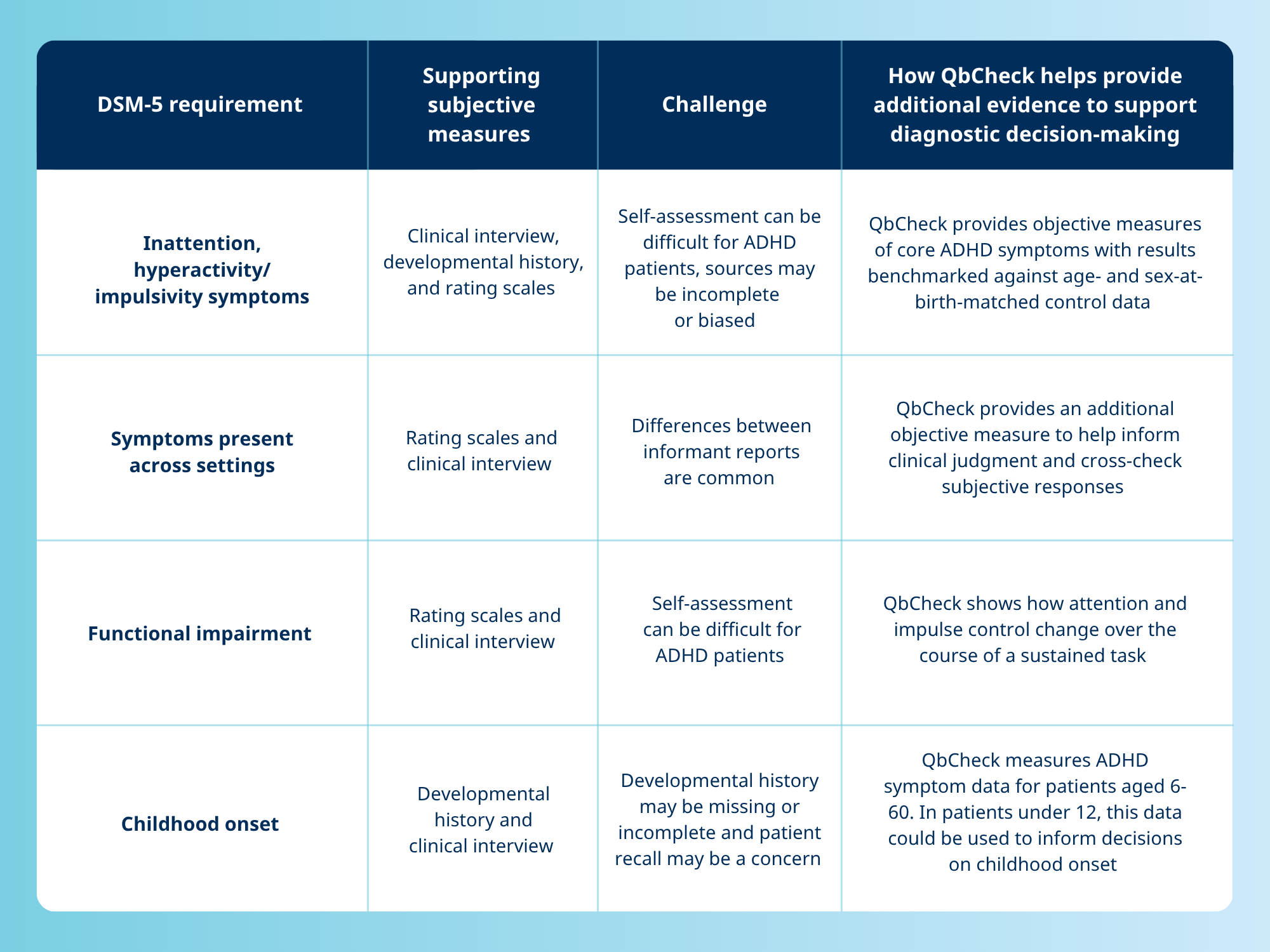
A diagnosis of ADHD using DSM-5 criteria requires several conditions to be met, including evidence of five or more symptoms for patients over 17 or six or more symptoms in children under 17. Symptom onset should happen before age 12, and symptoms should be evident in at least two settings (e.g., school, work, home, and social settings).
Subjective measures such as rating scales and parent and teacher reports may provide incomplete or conflicting reports of symptoms. This is where QbCheck can help by providing you with additional objective data to cross-reference subjective symptom reports.
How QbCheck can support a DSM-5 criteria ADHD assessment
Sources: Based on DSM-5-TR diagnostic requirements, international ADHD clinical guidelines, and published evidence base for QbCheck/QbTest. Qb testing is intended as an adjunct to clinical assessment and should not be used as a standalone diagnostic tool. Visit our Trust Center to learn more.
What evidence supports the use of QbCheck in clinical practice?
Over 50 clinical studies have been published on the use of Qb testing to support ADHD assessment and treatment. Let’s take a look at some of the latest research.
Monitoring treatment effect with QbCheck (Sanyal et al., 2025)
QbCheck can be a useful tool for monitoring ADHD medication effect, including remotely. Comparing test results before and after starting treatment can help you assess if dosages are working and symptoms are reducing. QbCheck recorded a statistically significant improvement in Total Symptom Score by 46.28%. QbCheck also showed significant correlations with commonly used subjective rating scales, supporting its validity as an objective measure of ADHD symptoms.
QbCheck’s reliability and diagnostic validity (Ulberstad et al., 2020)
QbCheck showed high test-retest reliability and good diagnostic validity. A sensitivity of 82.6 and a specificity of 79.5 were observed, with authors describing QbCheck as “a valuable test” that will “enable assessment of ADHD symptom levels in adolescents and adults outside the clinic in the home setting.”
Patient and clinician experiences of using QbCheck for ADHD
Real-world clinicians, patients, and healthcare providers have benefitted from our technology, here are their experiences:
Increasing ADHD assessment throughput while reducing subjective bias
Following the introduction of QbCheck, the ADHD 360 team were able to serve over 1,600 new patients per month in January 2025 – a 56% uplift compared with before QbCheck went live.
"QbCheck has been an absolute godsend. It’s intelligent, informative, and makes the diagnostic process quicker and more efficient.”
Carl also explains how QbCheck has helped improve consistency in ADHD assessments:
“The objective data [QbCheck] provides ensures that every patient is assessed using the same evidence-based criteria, regardless of where they are. Not only does this minimize the risk of subjective bias but also ensures that our clinical team can deliver reliable, high-quality care at scale.”
Increasing clinician confidence and reducing administration time

“The objective data [QbCheck] provides ensures that every patient is assessed using the same evidence-based criteria, regardless of where they are. Not only does this minimize the risk of subjective bias but also ensures that our clinical team can deliver reliable, high-quality care at scale.”
Understanding ADHD subtypes and profiles (MindWell Urgent Care)
QbCheck provides measures of hyperactivity, impulsivity, and attention levels. Dr. Ashkan Soltan has shared how these score breakdowns can help with assessing the differing symptom profiles of patients.

“What type of ADHD are we specifically dealing with? QbCheck really helps clarify that.”
Helping patients and parents visualize ADHD symptoms
Dr. Leah Nathan, Founder and CEO at The Mind Center, shares how QbCheck reports have helped parents to better visualize and understand their child’s ADHD symptoms:
“We've had a 100% hit rate with parents being really happy. It clears up a lot of frustration for them. I literally had parents saying, ‘Can I screenshot this graph?’ Like they were mind-blown from just, like, the visual depiction in the interpreter's report of this is how severe your kid’s ADHD is, or this is where the lever is for inattentiveness or hyperactive impulsivity type.”
Frequently asked questions about QB testing (FAQs)
1. What is QbCheck?
QbCheck is a computerized ADHD test providing objective measures on core ADHD symptoms of attention, activity, and impulsivity. Results are benchmarked against same-age and same-sex-at-birth control data. Our ADHD tests are used by thousands of clinicians worldwide, and over 1 million patients have taken a test.
2. Who is QbCheck for?
QbCheck is validated for use with patients aged 6–60. However, there have been trials using digital ADHD tests in older patients. A study of adults aged 55–79 found that an objective test correctly identified ADHD in around 70% of cases, rising to around 91% when results were combined with patients’ self-reports of their symptoms.
3. How long does QbCheck take?
The core QbCheck test takes around 15–20 minutes to complete. Additional time is needed for setup and completion of rating scales. Patients can complete the test remotely using their own compatible laptop or Mac, or take the test in a clinic.
4. Are results from QbCheck easy for patients to understand?
The results from QbCheck are presented in clear reports with both graphs and figures to illustrate findings. These can help you explain symptoms to patients and support their understanding as they see how their performance compares with the normative group.
5. Can QbCheck diagnose ADHD?
QbCheck is not intended as a standalone diagnostic tool and should be used as part of a comprehensive ADHD assessment alongside subjective measures like rating scales, clinical interviews, and gathering developmental history. The objective data from QbCheck can support your diagnostic decision-making by providing an additional source of objective information.
6. How does QbCheck compare with ADHD rating scales?
QbCheck and rating scales are different components of an ADHD assessment. Both tools can be used in conjunction with DSM-5 criteria to aid diagnostic decision-making. Rating scales are subjective and can be influenced by rater bias. False-positive results on ADHD rating scales are also common, with studies reporting positive predictive values below 20% for most rating scales and up to 61% for the best-performing scales.
The data from QbCheck is objective, and a sensitivity of 82.6% and specificity of 79.5% have been demonstrated when distinguishing adolescents and adults with ADHD from controls.
7. Can QbCheck be used remotely?
Yes, patients can take QbCheck tests at home. This can help to improve accessibility, reduce travel time, and support integration of digital ADHD testing in hybrid and virtual ADHD clinics.
8. Can QbCheck be used for ADHD treatment monitoring?
Sanyal et al., have highlighted how QbCheck can be used to “facilitate treatment monitoring and dosage titration.” The ability to compare test results after starting medication with baseline scores can help you assess treatment effect, even remotely.
9. How much would it cost to use QbCheck in my clinic?
QbCheck comes in flexible bundles and custom test options. Prices start from £65 / $68 / €75 per test, though features and pricing may vary based on your clinic’s requirements. Contact us using the form below to learn more about additional features and available integrations.