


Subjective data from rating scales, clinical interviews, and parent and teacher feedback provide essential information on both symptoms and impairment that helps you diagnose with greater confidence. However, subjective measures have limitations. They may present an incomplete, conflicting, or biased assessment of symptoms that can compromise ADHD diagnostic accuracy.
In this blog, we explore why subjective measures can lead to diagnostic variability, and what ADHD guidelines say about using multiple data sources. We’ll also discuss how you can make your ADHD assessments more robust by adding objective technology to your clinical workflow.
Subjective assessment methods used in ADHD diagnosis
There are several different means of collecting subjective data to inform an ADHD diagnosis; however, each has potential limitations.
Subjective ADHD assessment methods like rating scales and clinical interviews provide complementary insights into symptoms, impairment, and age of onset. Bias, incomplete responses, and an overreliance on patient or informant recall, however, may present an incomplete picture of symptoms.
| Method | Potential contribution to ADHD assessment | Potential limitations |
|---|---|---|
| Rating scales | Symptoms and impairment across settings | Rating scales may be incomplete or not returned. Responses may be subject to bias or issues in objectively assessing symptoms. They also have variable age ranges, meaning not all rating scales cover all age ranges. |
| Clinical interview | Symptoms and impairment across settings and persistence/age of onset | Relies on patient recall and ability to critically self-assess symptoms. Challenges in clinical judgment when interpreting feedback. |
| Parent/caregiver/teacher reports | Symptoms and impairment in specific settings | Responses may be subject to bias or issues in objectively assessing symptoms. |
| Developmental history | Symptom persistence/age of onset | Patients may struggle with recall, and records from schools or parents may not be available. |
| Supplementary information from family, school, or work | Symptoms and impairment in specific settings/corroboration of other sources | Additional information may not be available, or records may be incomplete or inconsistent. |
How subjective assessments can lead to diagnostic variability
Clinicians interpreting the data from subjective ADHD assessments face several challenges. ADHD patients can find self-assessment of symptoms difficult, recall issues may compromise responses, and masking or coping strategies may make assessment more difficult. Parent and teacher feedback may also conflict or show bias, and developmental history and supplementary information may be missing or incomplete.
All of this means that you may be presented with an inconsistent picture of patient symptoms. Clinical judgment is another variable, as different clinicians may reach different diagnostic conclusions about symptoms, impairment, the likelihood of other conditions, and whether diagnostic criteria are met.
Strengths of ADHD rating scales for diagnosing ADHD
Rating scales are one of the most widely used and established tools in ADHD assessment. Different models of rating scales include ADHD-RS IV, Vanderbilt, Conners 4, Adult ADHD Self-Report Scale (ASRS), and WEISS Functional Impairment Rating Scale. Many have been refined over time to reflect advances in ADHD research and clinical practice.
Rating scales are simple, quick to use, and inexpensive. They can also be repeated to capture changing symptoms over time or after treatment. We’ve curated a printable comparison table for you to quickly evaluate which tool best suits you and the patients you work with.
Weaknesses of using rating scales for ADHD diagnosis
Rating scales are highly subjective and can be compromised by rater bias. Differing behaviors across settings and the relationship between rater and subject may also affect ADHD rating scale results. This can lead to symptoms being over- or under-reported or even missed entirely.
An extensive study into 11 widely used rating scales found that ‘no single assessment tool was adequate for ADHD diagnosis,’ and instead recommended a multi-method assessment approach.
ADHD diagnosis recommendations by US guidelines
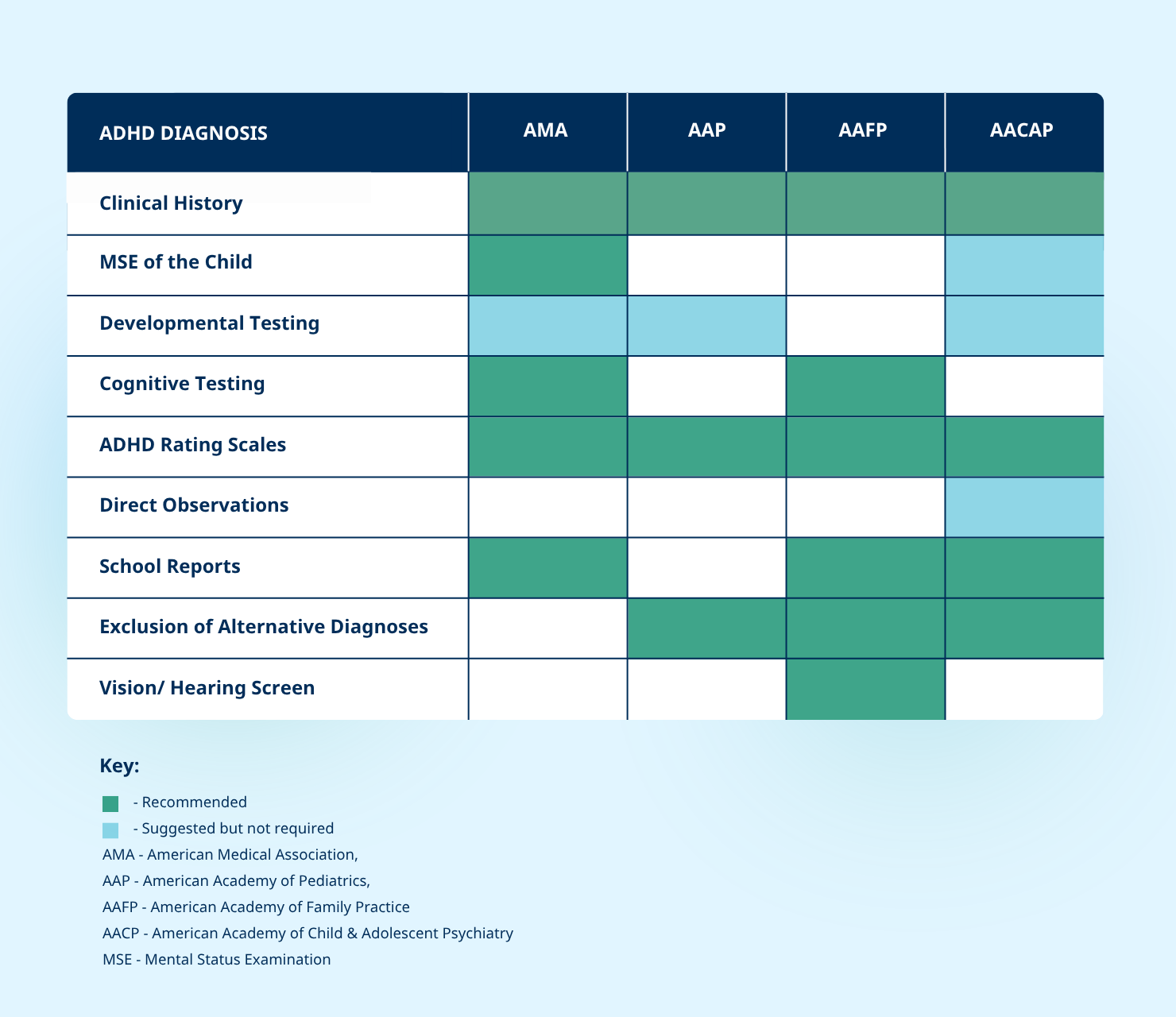
What does a high-quality ADHD assessment look like in 2026?
Modern ADHD clinics are delivering comprehensive assessments that go beyond using subjective measures. Objective ADHD technology, like QbCheck, can be more robust against rater bias and the errors that occur in subjective assessments.
What the evidence says about multi-method ADHD assessments
There is documented support for using multiple methods, informants, and sources when assessing ADHD. Let's take a look at some examples –
- A comprehensive study reviewed 8 major ADHD guidelines, including AAP and clinical practice guidelines from Australia, Canada, England (NICE), Scotland, and Europe. 5 of 8 frameworks explicitly mentioned adopting a multi-disciplinary approach to ADHD assessment, with recommendations to seek multiple third-party reports, school records, previous health assessments, and to work across disciplines
- NICE NG87 explicitly states that ‘a diagnosis of ADHD should not be made solely on the basis of rating scale or observational data’
- McConaughy et al., describe multimethod approaches as particularly important, as symptoms and impairments can manifest differently across settings and relationships
- Vogt and Shameli state that the complexity of ADHD assessments requires a multimodal, multiprofessional, and multi-agency approach
- Grandjean et al., cite best practice as triangulating information via a comprehensive diagnostic approach that draws on information from multiple sources
Including an objective measure provides additional data on a patient’s activity, attention, and impulsivity. This can be used to cross-validate findings from other assessment sources and help reduce subjectivity. Objective data can also be helpful where masking, compensation strategies, or developmental concerns may make subjective accounts less reliable.
Adding the combined attention, activity, and impulsivity score from QB testing to rating scales may also help improve differentiation of ADHD and ASD in adults. These strengths make QB testing a reliable ADHD screening tool for reducing diagnostic uncertainty.
Frequently Asked Questions (FAQs)
Many of the same concerns over bias, reliability, and subjectivity that apply during initial assessment can also be a concern during follow-up tests to review ADHD medication and treatment effect. Qb testing can be more sensitive to medication effects than patient self-rating, at both one-month and six-month follow-up visits. QbCheck can even be used for remote monitoring of ADHD treatment, without the need for the patient to come to your clinic.
QbCheck and QbTest are objective ADHD tests providing measures of patients’ ADHD symptoms. These are benchmarked against same-age and same-sex-at-birth control data for individuals without ADHD.
Qb testing is a recommended clinical assessment technology with quantifiable results. However, it is not intended as a standalone diagnostic tool. Instead, data from Qb testing should be considered alongside subjective measures to support diagnostic decision-making.
Adding objective test data to subjective measures can deliver an accuracy of 89.5% for ADHD diagnosis, and increase clinician confidence in making diagnostic decisions.
False positive results on ADHD rating scales are common. A systematic 20-study review found that positive predictive values for ADHD rating scales were below 20% for most rating scales, with the best performing scales at 61%. This means a substantial proportion of positive results are false positives. Studies have also highlighted the risk of distorted results if rating scales are completed dishonestly, with symptom checklists like the ADHD Rating Scale and Conners's Adult ADHD Rating Scale–Self-Rating Form identified as particularly susceptible.
There are several reasons why subjective measures may identify different behaviors in different settings. This could be due to different responders providing feedback and the risk of bias or difficulty in objectively assessing symptoms. However, this situation may also arise due to context-driven behaviors, meaning ADHD symptoms do not show up consistently. The objective data from Qb testing can help provide clarity as to whether symptoms are evident under test conditions.