


Consistent models of ADHD care improve patient experience while maximizing operational efficiency. Having multiple clinicians operating across separate sites increases the likelihood of service delivery varying and inconsistent patient experiences.
In this blog, we explore how you can build consistent systems of ADHD care that operate across an entire service. By creating structured workflows early, you can ensure they support growth rather than becoming shaped reactively as your service expands.
Disclaimer – The step-by-step guide in this blog is provided for informational purposes only. It is not intended as an implementation guide and should be reviewed alongside relevant guidance, local policies, and professional judgment. Reader discretion is advised.
Why consistency matters in ADHD assessment
Following a standardized process for ADHD assessment can help build patient trust and ensure expectations are met. Legion Health, a Texas-based psychiatric clinic, introduced a more standardized and consistent model of ADHD assessment using QbCheck. They found that time to diagnosis reduced and retention rates increased. Patients also reported improved understanding of symptoms and diagnosis.
Standardizing ADHD care also has operational advantages. It creates a scalable model for growth, so you can increase capacity while reducing administrative burden. It also gives you a clearly defined service model to market to patients, covering every clinic location.
Disadvantages of diagnostic variation between clinicians
Inter-clinician variability can occur during the ADHD assessment process. Rating scales, clinician interview, patient, parent, and teacher feedback, and developmental history are all valuable tools in an ADHD assessment. However, all are subjective and may be affected by a patient’s recall, coping strategies, or the ability of the patient or respondent to accurately assess symptoms.
This can lead to clinicians being presented with an inconsistent picture of a patient’s symptoms. Different clinicians may reach different diagnostic conclusions as a result.
Why achieving ADHD assessment consistency is difficult for growing clinics
One of the challenges for larger ADHD services is that growth often introduces inconsistency. Each new clinician uses slightly different ADHD assessment tools. Clinical judgment will also vary so the same data may receive different interpretations.
Achieving consistent ADHD service quality at scale often requires active system redesign – here’s a plan you can follow.
How to standardize ADHD assessments
A 5-step guide for growing clinical teams
Through service redesign, collaboration, governance, and innovation, you can improve service consistency while maintaining quality across multiple clinicians.
Step 1 – Define the ADHD assessment clinical standards you want to follow
Clinicians working in your ADHD service will need to reach a consensus on what ADHD service quality looks like.
You may adapt a framework such as CFIR, or develop one of your own. Ensure you answer questions such as:
- Define what a quality ADHD assessment looks like – what data must be collected, tools used, and processes followed
- Agree which clinical guidelines and diagnostic frameworks (such as DSM-5, ICD-11, and NICE guidance) should be followed
- Visualize and map the intended patient journey through your ADHD service
Practical takeaway –
Define in detail what a quality ADHD assessment looks like, so all clinicians can work to the same standards.
Step 2 – Design an ADHD workflow that meets your vision for a quality service
Having defined what you want your ADHD service to look like, you need to design a workflow that can deliver that vision.
- Map out each stage of your ADHD assessment clinical pathway, from referral through to diagnosis
- Create a standardized patient journey through your workflow, so that each patient has the same experience, while allowing flexibility where necessary
Discover how to optimize service efficiency with technology-driven workflows and smarter triage.
Practical takeaway –
Design a standardized workflow that will take each patient from referral to diagnosis consistently.
Step 3 – Calibrate for consistency through onboarding and training
For scaling clinics, ensuring all clinicians follow the same standardized approach requires training and calibration.
- Onboard new clinicians so that they follow the standardized ADHD workflow and practices
- Provide training and support to existing team members, especially if using a new technology
- Regularly calibrate clinical practices to ensure alignment with the standardized ADHD workflow
Practical takeaway –
Staff will require support and training to ensure the new ADHD workflow is followed.
Step 4 – Use standardized evidence to support ADHD diagnostic decisions
Introducing standardized tools to the ADHD assessment process improves consistency and supports clinicians in diagnostic decision-making.
- All clinicians should use the same standardized ADHD assessment tools during assessment
- Use data from multiple sources during assessment – this aligns with NICE guidance and provides a more comprehensive picture of symptoms and impact
- Integrate digital ADHD tools such as QbCheck to support clinical judgment with objective data
Practical takeaway –
Using standardized ADHD assessment tools supports a more consistent patient care journey.
Step 5 – Measure performance of the new workflow and refine where needed
Once your clinical workflow has been implemented, you will need to define and monitor clinical, operational, and patient metrics.
- Track metrics to identify if the revised workflow is successful
- Review patient feedback to assess if there is variation between clinicians or sites
- Use findings to refine processes, drive continuous improvement, and ensure alignment of approaches between clinicians and sites
Practical takeaway –
Define and monitor performance outcomes to assess if consistency has been achieved and refine if necessary.
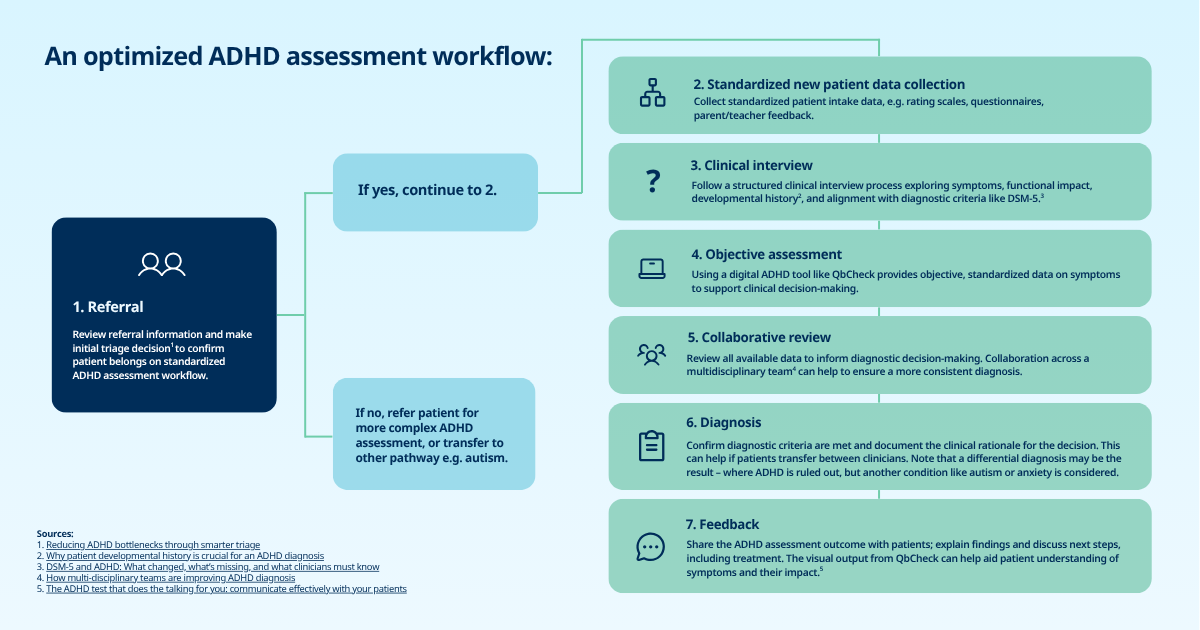
What does an optimized ADHD assessment workflow look like?
Once you have followed each of the steps above, you should have designed and implemented a workflow that guides each patient through your service consistently from referral to diagnosis and feedback.
Sources:
1. Reducing ADHD bottlenecks through smarter triage
2. Why patient developmental history is crucial for an ADHD diagnosis
3. DSM-5 and ADHD: What changed, what’s missing, and what clinicians must know
4. How multi-disciplinary teams are improving ADHD diagnosis
5. The ADHD test that does the talking for you: communicate effectively with your patients
How QB testing fits into a standardized workflow
Objective ADHD technology can be an effective means to standardize a workflow. For example, QB testing with QbCheck provides quantitative data on a patient’s ADHD symptoms, which is benchmarked against same-age and same-sex-at-birth comparative data.
Using QB testing can reduce the time from assessment to final decision, increase the number of diagnostic decisions, and improve clinician confidence in decision-making, without compromising diagnostic accuracy.
Please note however, that QB testing is not a stand-alone means to ADHD diagnosis. It is intended to be used alongside subjective assessment methodologies like clinical interviews, developmental history, and rating scales.
Using rating scales in your ADHD assessments? Use our rating scale comparison tool to find the most suitable rating scale for your ADHD service.
Frequently asked questions (FAQs)
To standardize assessments in a multi-clinic ADHD service with multiple clinicians, you will need to clearly agree and define standardized processes, use the same assessment tools, provide training to support adoption, and monitor performance to ensure continued adherence.
No, because clinical judgment is still the deciding factor in reaching a diagnostic decision. Standardizing workflows or assessment processes can help reduce inter-clinician variability in ADHD diagnostic decisions. It also means your patients have a more consistent experience.
A standardized ADHD workflow consistently guides patients through the process of being assessed for ADHD so that they receive the same experience and are assessed using the same methodologies and tools, regardless of which clinician they see. However, an effective workflow still allows for personalization of care and escalating more complex cases for more tailored assessment.
Clinical leaders and decision makers can use regular refresher training and calibration sessions to support consistent application of standardized processes. Comparing patient feedback from different sites and clinicians can also be a useful way to monitor operational consistency.