

DSM-5 provides one of the most widely used sets of criteria for diagnosing ADHD. To determine whether DSM-5 criteria are met, clinicians typically review evidence from multiple sources to build a picture of a patient’s symptoms. This may include data from clinical interviews, developmental history, and rating scales.
In this blog, we explore how you can use objective technology alongside subjective measures to support your clinical judgment.
Let’s take a more detailed look at the DSM-5 criteria and how data from QB testing can add value alongside the information gained from subjective measures.
Disclaimer – This blog is for general information only, sourced from reputable and reliable references. It is not medical advice, nor should it be used as a substitute for professional guidance. Qbtech is not liable, and reader discretion is advised.
How to assess ADHD using DSM-5
The DSM-5 outlines diagnostic criteria for assessing whether a patient’s symptoms are consistent with ADHD. The criteria describe common behaviors and symptom patterns using examples from everyday life, like forgetfulness or restlessness.
To meet the diagnostic criteria, children under 17 must present with six or more symptoms of inattention and/or hyperactivity-impulsivity. For patients aged 17 and over, the threshold is five or more symptoms in one or both symptom domains.
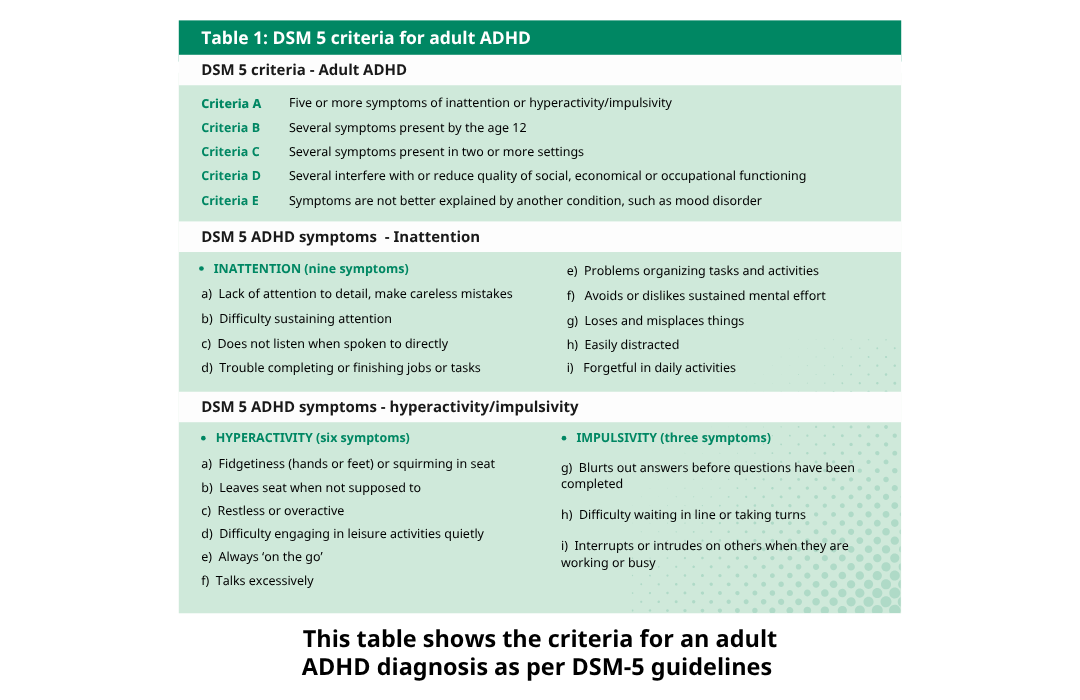
Additionally, symptom onset should happen before age 12, and symptoms should be evident in at least two settings (e.g., school, work, home, and social settings).
For a more detailed exploration of DSM-5 and for comparisons with other ADHD diagnostic frameworks, read our DSM-5 vs. ICD-10, ICD-11 and NICE blog.
Key sources for checking against DSM-5 ADHD criteria
Each part of an ADHD assessment provides different types of evidence that can help you determine whether DSM-5 criteria for ADHD are met.
| Assessment Component | Evidence |
|---|---|
| Clinical interview |
|
| Rating scales |
|
| Developmental history |
|
| QbCheck |
|
| Clinical judgement |
|
Using rating scales in your DSM-5 ADHD assessments? Refer to our ADHD rating scale comparison guide to discover the best fit for your clinic.
How QbCheck assessments support DSM-5 diagnosis
A comprehensive ADHD assessment, which draws on data from multiple sources and respondents, helps clinicians establish whether a patient’s symptoms align with the DSM-5 criteria for ADHD.
Incorporating a digital ADHD test like QbCheck helps provide additional objective data on attention, activity, and impulsivity levels. This approach also aligns with the ADHD guideline NICE NG87, which advises using multiple data sources during diagnosis.
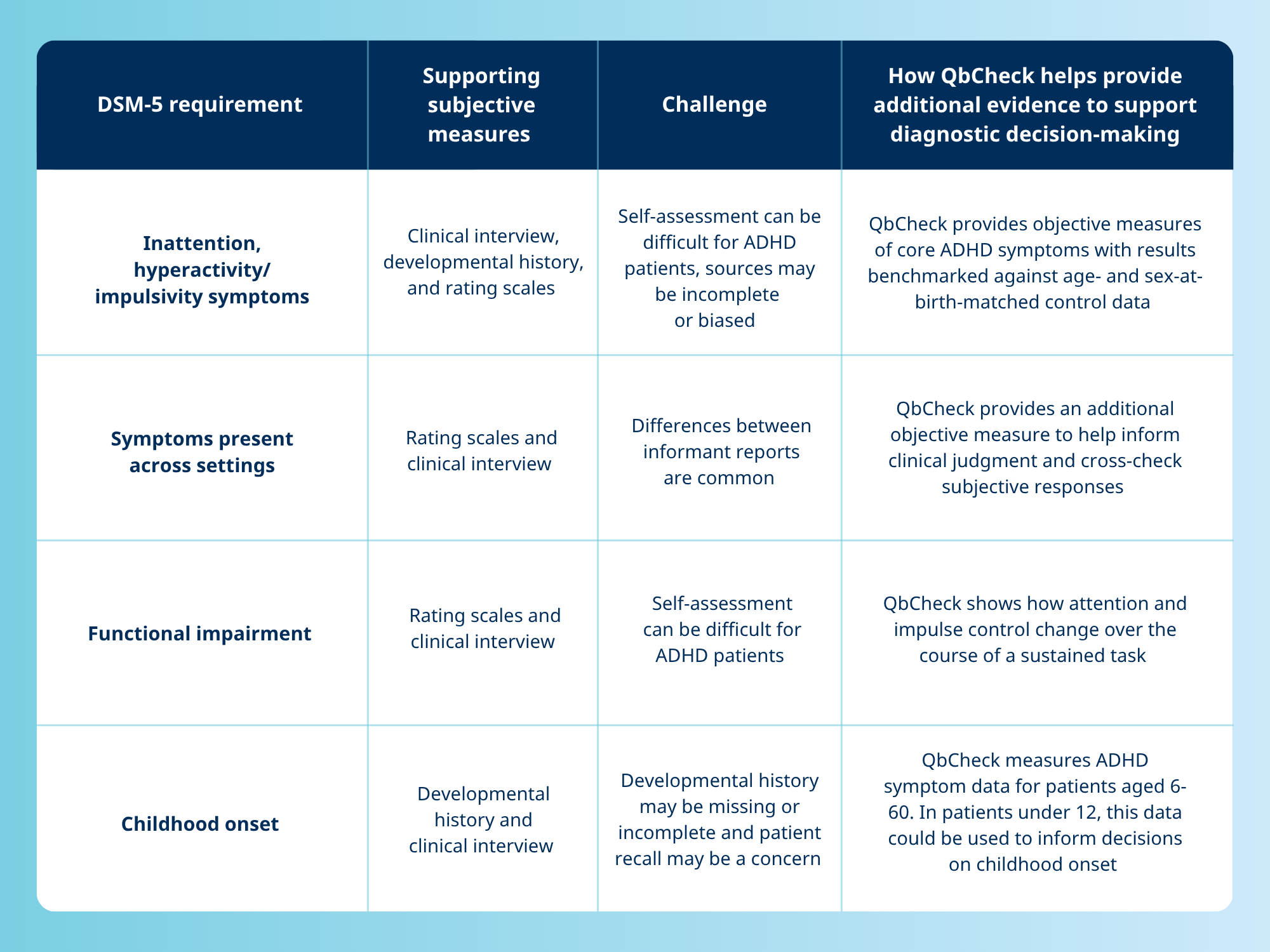
Source: Based on DSM-5-TR diagnostic requirements, international ADHD clinical guidelines, and published evidence base for QbCheck/QbTest. QB testing is intended as an adjunct to clinical assessment and should not be used as a standalone diagnostic tool.
Criticisms of the DSM-5 criteria for ADHD
Some experts argue that the DSM-5 criteria for adult ADHD are flawed. Evidence from multiple sources may not always provide a consistent picture of their patient’s symptoms. There are some concerns that the DSM-5 criteria may be too focused on child behaviors, male-biased, and overemphasize hyperactivity symptoms. These challenges can make clinical decision-making more complex. Therein arises the need for objective data to back clinical decisions.
How QbCheck can give clinicians more confidence when diagnosing ADHD
Introducing an objective test, like QbCheck, alongside subjective measures, can help you:
- Cross-check the findings from different symptom reports
- Identify inconsistencies in conflicting responses
- Gain objective insights into the presence of the core symptoms of ADHD
- Visually compare your patients’ ADHD test results with benchmark control data
- Reach diagnostic decisions with increased confidence
Why subjective measures may introduce uncertainty
Much of the evidence available to clinicians during an ADHD diagnostic evaluation is subjective. This could contribute to an incomplete or inconsistent picture of a patient’s symptoms. Here’s why:
- Parent and teacher reports on ADHD may conflict
- Responder bias may lead to over- or underreporting symptoms
- Rating scales are not always returned or can be sent back partially complete
- Developmental history may not be available for adults
- Older adults may struggle with recall bias or forgetfulness, making judgments on symptom presence across the lifespan difficult
- ADHD patients often struggle with self-evaluation and tend to overestimate symptoms
What is QB testing and what role can it have in ADHD assessments using DSM-5?
QB testing is a standardized, evidence-based process of ADHD testing using either QbCheck or QbTest. Clinicians are provided with objective measures of a patient’s attention, activity, and impulsivity under test conditions. Results are benchmarked against age- and sex at birth-matched data from a control group without ADHD.
QB testing data, alongside subjective measures, support better diagnostic decision-making during a DSM-5 ADHD assessment. Please note that QbCheck is not a standalone diagnostic tool. It does not diagnose ADHD or replace clinical judgement.