


ADHD services have no shortage of clinical guidance. NICE, DSM-5, AAP, and ICD-11 all provide evidence-based recommendations.
Successful organizations build on the evidence available and translate guidelines into localized, practical ADHD clinical workflows. Let’s dive into exactly what steps you need to take to turn guidelines into clinical practice for ADHD service improvement.
Table of contents
- Evidence-based ADHD care: definition
- Step-by-step framework to implement ADHD guidelines
- Resources for ADHD clinicians and service leaders
- Practical ways to turn guidelines into practice
What is evidence-based ADHD care?
Evidence-based ADHD care is assessing and treating patients using approaches supported by research and recognized clinical guidelines. This may include using an objective ADHD tool like QbCheck to aid in the diagnostic and treatment process.
Why is it difficult to implement ADHD research?
Implementing research and evidence-based ADHD care is often more challenging than identifying the evidence itself. Many services face system-wide constraints such as workforce shortages, growing referral volumes, long assessment waitlists, competing organizational priorities, and budget pressures.
These factors can make it difficult to consistently translate clinical guidelines into everyday practice, leading to workflow bottlenecks, variation in care, and difficult trade-offs between maintaining quality and meeting demand.
We’ve curated a 5-step framework that understands both the clinical and operational realities of ADHD care. With this guide, our aim is to help you translate research into clinical practice and consistently implement clinical guidelines.
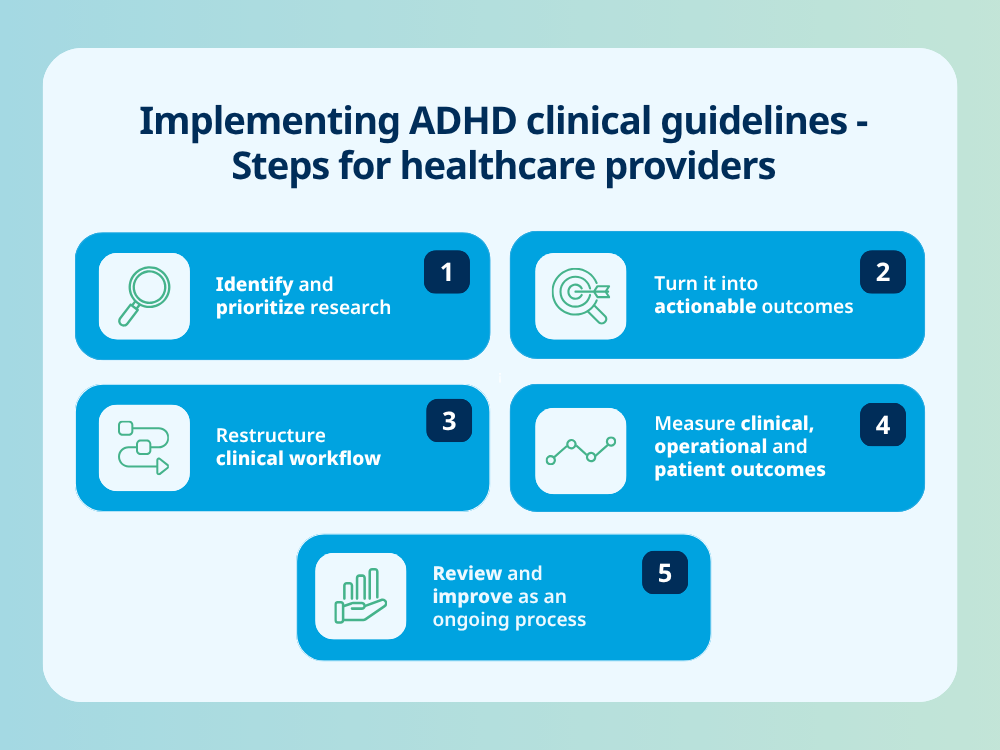
5-step framework for implementing ADHD clinical guidelines
Disclaimer: This framework is based on the principles of the Knowledge-to-Action-Framework. It is not intended as an exhaustive guide. It is advised to review it alongside relevant guidance, local policies, and professional judgment.
Step 1 – Identify and prioritize the research you wish to incorporate into your ADHD clinical workflow
Before making changes, you should critically review new evidence to determine whether it is a good fit. Consider factors such as relative advantage, adaptability, complexity, cost, and fit with local needs.
For example, the Consolidated Framework for Implementation Research (CFIR) is a useful framework for assessing the suitability of new evidence for implementation.
You may adapt a framework such as CFIR, or develop one of your own. Ensure you answer questions such as:
- Is the evidence robust?
- Would it benefit the clinic and patients?
- Does it align with recognized clinical guidelines (e.g., NICE, DSM-5, ICD-11, AAP)?
- Is implementation clinically, operationally, and financially feasible?
- Can it be adapted to your service without compromising quality?
Any new evidence should pass this critical review before progressing to the next stage of implementation.
Practical takeaway –
Create a formal process, flowchart, or checklist to help you critically assess new evidence and its suitability for your clinic.
Step 2 – Turn ADHD guidelines into an actionable implementation
This is where many implementation projects succeed or fail. Clinical guidelines are intentionally broad so that each service translates the research into something that reflects its staffing, patient population, constraints, and ways of working.
First, you will need to define your current ADHD workflow:
- How many patients do you see?
- Who is in your clinical team (roles and responsibilities)?
- What processes and technologies are used?
Second, you could identify how new research recommendations could be introduced to this workflow:
- What about the current workflow needs to change?
- What may be difficult to implement?
- What would the adapted workflow look like?
- What would team roles be in the revised workflow?
By the end of this stage, you should have a clear roadmap to implement a new workflow.
Practical takeaway –
Define your current workflow, then assess how evidence-based recommendations can be incorporated and identify the changes needed to implement them.
Step 3 – Implement your redesigned ADHD workflow and train staff in its delivery
Once you have finalized your new workflow design, it will need to be implemented. Within ADHD care, this may involve embedding improvements such as the following:
- More consistent ADHD assessment data collection
- Introducing triage systems to improve patient journeys
- Adding objective ADHD tests like QbCheck to your workflow
- Upskilling and training team members in new assessment methods
- Introducing psychoeducation to support patients
- Revised medication titration and follow-up processes
- Clear escalation routes for complex cases
Staff training may be required to support the delivery of a new ADHD workflow, particularly if embedding new technologies or if staff are taking on different roles.
A more standardized workflow can reduce variation in assessment and treatment and ensure a clear, consistent patient experience. It also provides a model for implementation across multi-clinic sites so that all patients receive the same high standard of care.
Practical takeaway –
Implement the new workflow and undertake staff training in new systems and technologies.
Step 4 – Measure clinical, operational, and patient outcomes
Any new evidence-based processes or approaches should demonstrate an expected advantage or benefit under Step 1. Now, you should consider how that would be evidenced in outcomes. For ADHD care, this may include:
- Reduced ADHD waitlists
- Increased assessment throughput
- Better diagnostic consistency across clinicians or sites
- Reduced time to diagnosis or treatment initiation
- Improved or quicker medication stability
- Improved patient-reported outcomes (e.g., satisfaction)
Following a system-wide workflow redesign, you should aim to define and monitor metrics covering clinical, operational, and patient outcomes.
Practical takeaway –
Define specific outcomes that will be used as measures of system success and commence monitoring.
Step 5 – Use continuous improvement to strengthen ADHD services
By reviewing the metrics defined at Step 4, you can identify if aspects of your redesigned ADHD workflow are not working. It is likely that during real-world implementation some things will need to change. You can then go back through Steps 2-4 to investigate if there are better ways of incorporating the relevant research or guideline.
When reviewing your workflow and the incorporation of any new processes, consider:
- Performance of the new workflow
- Feedback from clinicians and patients
- Whether there have been any unintended bottlenecks or issues
- If the implemented process still delivers against your criteria from Step 1 – i.e. it remains viable from a cost, clinical and operational perspective
Practical takeaway –
Regularly review metrics for signs of workflow success or failure. Use this as foundation for continuous improvement with refinements made where necessary.
Note: Implementation science frameworks such as the Knowledge-to-Action Framework help healthcare organizations bridge the gap between published evidence and routine clinical practice by providing structured approaches to adoption, evaluation, and continuous improvement.
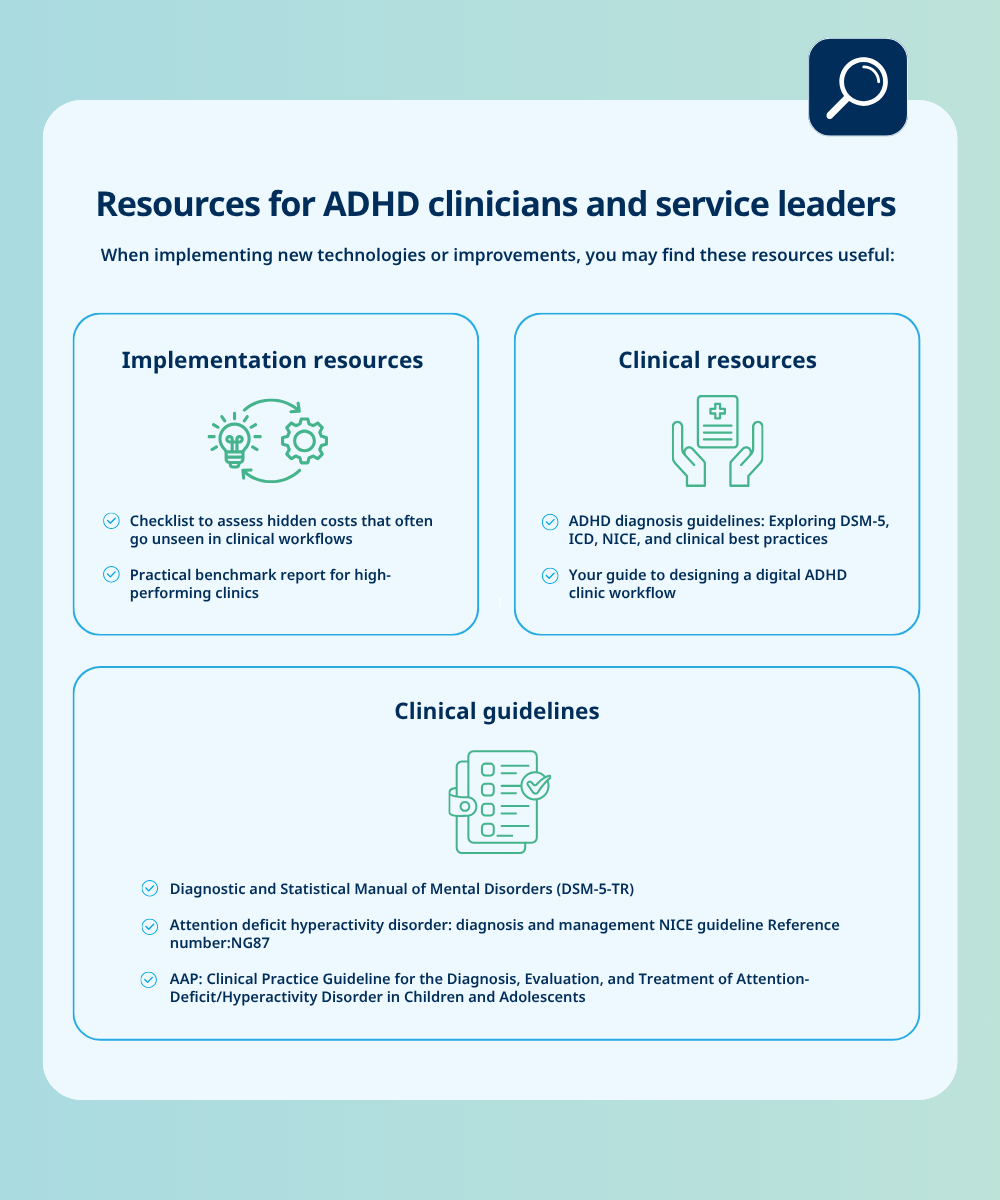
Resources for ADHD clinicians and service leaders
When implementing new technologies or improvements, you may find these resources useful:
Implementation resources
Clinical resources
Clinical guidelines
- Diagnostic and Statistical Manual of Mental Disorders (DSM-5-TR)
- Attention deficit hyperactivity disorder: diagnosis and management NICE guideline Reference number:NG87
- AAP: Clinical Practice Guideline for the Diagnosis, Evaluation, and Treatment of Attention-Deficit/Hyperactivity Disorder in Children and Adolescents
Turning ADHD guidelines into everyday clinical practice
Services that combine structured implementation, staff engagement, ongoing measurement, and continuous improvement are better positioned to deliver consistent, scalable care without compromising clinical quality.
Working with a partner experienced in both clinical ADHD assessment and service design could help you bridge this gap between evidence and implementation.
Speak to our experts about redesigning your ADHD workflow by filling out the form below.