

Today, different types of tools and technology exist to aid in pre-assessment, assessment, and treatment of ADHD. This plethora of choice can make it difficult to identify the right tool for your clinic, patients, and ADHD workflow.
To make things easier, we’ve developed this guide, exploring the different types of ADHD tests in the market, also listing what clinicians should look for when choosing a new testing technology.
We’re also including a practical checklist for comparing ADHD tests, so you can choose a test that aligns with your established clinical approach, to strengthen, and not replace, clinical judgment.
This page was last updated: 26
Disclaimer: This is a non-exhaustive, quick-reference guide based on leading guidelines and resources. Qbtech makes no representation or warranty of any kind regarding the accuracy, validity, or reliability of any information on the site. Reader discretion is advised. For more information, visit our legal page.
What to look for in an ADHD test
No ADHD testing method or device should be used to diagnose ADHD on a standalone basis. Most guidelines, instead, recommend that any tool or technology should be considered as part of a multidisciplinary approach to ADHD assessment and treatment.
When evaluating an ADHD assessment tool, clinicians may want to consider whether:
- Measures ADHD-related behaviors or symptoms consistently, with evidence supporting its reliability and validity
- Aligns with established diagnostic frameworks and clinical workflows, supporting the broader integration across your practice
- Provides easy-to-understand results that help patients understand relevant aspects of their assessment
- Can be administered consistently over time, where appropriate, so clinicians can compare results and monitor changes using standardized measures
What tests and tools are currently used to assess ADHD?
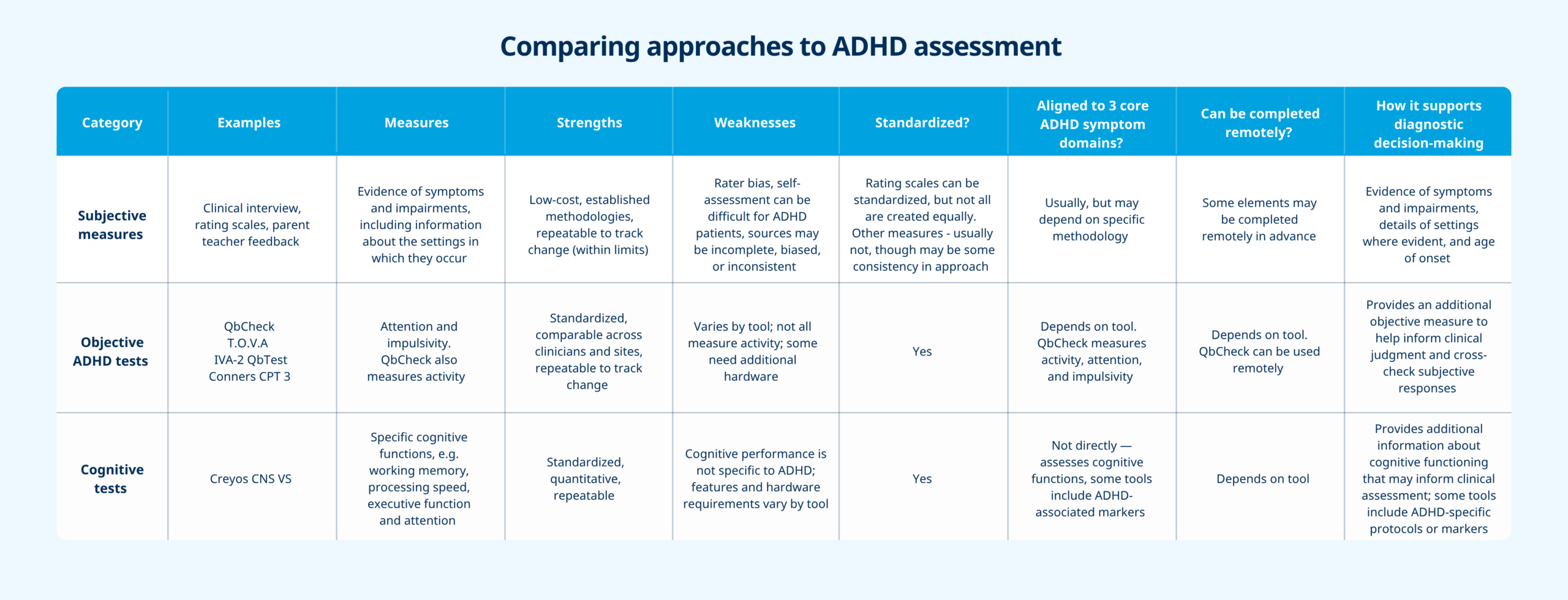
Current approaches to ADHD assessment broadly fall into 3 main categories: subjective, objective, and cognitive.
While a fourth area is emerging around technologies such as wearable devices, eye-tracking technologies, EEGs, and other biological or physiological measures, these approaches are not yet routine components of an ADHD assessment.
What are subjective ADHD testing measures?
Subjective measures focus on capturing symptoms, behaviors, and impairments based on feedback from the patient and people who know them well (parents, partners, teachers, etc).
Examples of subjective testing measures: clinical interviews, rating scales, and parent and teacher feedback.
Strengths:
- Generally low cost, but subject to administrative load
- Easy to implement
- Well established (some rating scales have been through several iterations)
- Can be repeated to assess symptom change over time or after starting treatment
Weaknesses:
- Responses may be incomplete, inconsistent, or conflicting
- Can be compromised by difficulties with self-reporting or responder bias
What is objective ADHD testing?
Objective ADHD tests measure a patient’s performance on a standardized task and provide quantifiable data on behaviors relevant to ADHD, such as attention and impulsivity. Some tests also measure activity or motor behavior. For instance, QB testing incorporates motion tracking that can detect movements as small as 1 mm during the task.
Examples of objective ADHD testing technologies: QbCheck, T.O.V.A., IVA-2, QbTest, and Conners CPT 3.
Strengths:
- Provides standardized, objective data on symptom-related behaviors under test conditions
- Results can be used to validate subjective observations alongside clinical interviews
- Can support a standardized assessment process across clinicians and multi-site clinic locations
- Can help monitor treatment effects and support long-term care
- Some objective tests, like QbCheck, provide measures of activity, attention, and impulsivity, providing objective information relevant to the core areas of ADHD symptoms
Weaknesses:
- Features and functionality can vary between tests. They aren’t interchangeable
- Not all tests provide a measure of activity, despite hyperactivity being one of the 3 core symptoms of ADHD
- Reporting formats vary between assessments; some provide patient-facing visualizations, while others are primarily designed to support clinician interpretation
- Objective tests cannot be used in isolation to diagnose ADHD; diagnosis requires a comprehensive clinical assessment
How are cognitive tests used in ADHD assessments?
A cognitive test assesses a specific cognitive function, such as working memory, processing speed, or executive function. These tests are not specific to ADHD, but the data they provide can be used to observe cognitive functions.
Examples of cognitive tests: Creyos (Formerly Cambridge Brain Sciences) and CNS VS.
Strengths:
- Provides standardized, quantitative data on specific cognitive functions, which can help identify areas of cognitive difficulty or impairment
- Cognitive tests can be repeated to monitor changes in cognitive performance over time
- Some tools may include ADHD-specific protocols or markers
Weaknesses:
- Cognitive functions are not specific to ADHD, so while they can identify potential areas of impairment, results alone may not distinguish ADHD from other conditions
- Features, functionality, and administration requirements can vary between tests
- Some cognitive tests use game-like elements, which may influence patient performance
- Some cognitive assessments may also require additional hardware
What to consider when choosing an ADHD test
Answering these questions will help you identify and prioritize your clinic's and patients’ needs to select an effective ADHD test.
Disclaimer: These questions have been developed with reference to reputable clinical guidance and research, including NICE (NG87) and its Evidence standards framework for digital health technologies, AAP Clinical Practice Guideline for ADHD, CHADD's Clinical Practice Tools, European ADHD Guidelines Group's recommendations on remote ADHD assessment, and independent research. It is intended for general informational purposes and does not replace professional clinical judgment.
1. What role will the ADHD test play in your assessment?
You should define what the primary goals of adding a new test to your ADHD workflow are.
Are you seeking a tool that:
- Supports diagnosis?
- Aids clinical decision-making?
- Establishes a baseline of symptoms?
- Helps you monitor symptom change over time?
- Adds objective information?
- Standardizes your assessment approach across clinicians and clinic locations?
2. Who are you assessing for ADHD?
The demographic profile of your patients and their specific needs will also inform your decisions.
Are your patients:
- Children, adults, or both?
- Likely to want or need remote ADHD testing?
- Able to complete an ADHD assessment independently?
3. What patient data do you need to collect?
Consider what data you need to complement or improve your ADHD assessment workflow.
Do you need a test that:
- Objectively measures ADHD-related symptoms or behaviors?
- Complements existing subjective measures like rating scales and clinical interviews?
- Can be compared with normative data?
- Can be used consistently across assessments?
- Displays results visually so that they can be shared with patients?
4. What evidence supports the new ADHD technology or tool?
When introducing a new tool, you want to be confident it will meet expectations.
Look for evidence that the test:
- Measures what it is intended to measure
- Is appropriately validated
- Meets necessary regulatory standards for your location
- Is validated for use with the patient age groups and populations you assess
- Is supported by independent research and evidence
5. How will the new ADHD test fit your current workflow?
A new test should complement your existing assessment process rather than introduce new complexities.
Define:
- When in your assessment workflow the test will be administered
- Who will administer, oversee, and review the test
- Whether the test can integrate with your existing systems and processes
6. Will clinic staff need training to use the new tool?
Do your staff have the knowledge and skills to use new testing technologies?
Consider:
- How much training is required before staff can use the test
- Who needs to be trained
- What ongoing support is required (and if this is available)
- What instructions, documentation, and training are provided with prospective new technologies
7. Do you need the new technology to be used in remote assessments?
If your service plans to offer remote or hybrid ADHD assessments, consider whether the test can be used effectively outside the clinic.
Does any potential new technology:
- Allow for remote testing?
- Work with patients' own devices?
- Allow clinicians to review results remotely?
- Align with your clinic’s data security and privacy policies?
8. How will you evaluate whether implementation has been successful?
Before selecting a new technology, define how you will assess whether implementation is successful in the future.
Consider how you will evaluate:
- Whether the test is being used as intended?
- Whether consistency or efficiency in your assessment process has improved?
- Whether clinicians and patients find the results useful?
- Whether the technology is delivering the outcomes you identified when selecting it?
How to compare ADHD tests: a practical checklist
Use this short checklist to help evaluate potential ADHD testing tools and technologies and see if they're a good fit for your clinic.
How do new ADHD testing technologies compare with rating scales?
Rating scales are one of the most established tools in ADHD assessment, with a wide range of tools available, some of which have been refined over years of use. However, rating scales are not intended as standalone diagnostic tools.
NICE NG87 states that ‘a diagnosis of ADHD should not be made solely based on rating scale or observational data’ and an extensive study into 11 widely used rating scales found that ‘no single assessment tool was adequate for ADHD diagnosis.’
Rating scales' results can also be affected by differing behaviors across settings, the relationship between rater and subject, and concerns over rater bias.
When considering a new ADHD testing technology, it can be beneficial to find a tool that both complements rating scales and also has strengths where rating scales fall short.
An objective test can be more robust against rater bias and rating scale errors. You can also use the results from an objective test alongside rating scales to provide an additional perspective and help reduce reliance on subjective measures.
QbCheck – an objective testing solution for your ADHD service
QbCheck is an objective ADHD test providing you with measures of a patients’ activity, attention, and impulsivity. It is FDA-cleared, MDR-certified, and CE-marked, and intended for use with patients aged 6–60 years. Results are benchmarked against a normative control group of same-age and same-sex-at-birth individuals to support diagnostic decision-making.
QbCheck can be used remotely, and results are presented visually to aid patient understanding. A sensitivity of 82.6 and a specificity of 79.5 have been found by a recent study. The technology has also been demonstrated for remote treatment monitoring, showing statistically significant improvements in Total Symptom Scores by 46.28% when assessing symptoms after treatment initiation.
Frequently Asked Questions
No test or technology can diagnose ADHD on a standalone basis. Several ADHD guidelines recommend a multi-modal approach to ADHD assessment. Using subjective testing methodologies alongside a digital ADHD test or objective tool can provide you with additional data to support diagnostic decision-making.
An ADHD test is a specific component of an ADHD assessment. Completing a rating scale could be one ADHD test, while taking an objective test could be a second, separate test. An effective ADHD assessment combines information from different tests and other sources, with the clinician drawing on these findings to reach a diagnosis.
Before adding a new ADHD technology or testing tool to your clinic, you need to identify your clinic’s requirements and assess which tool can best meet these. It is recommended to look at the independent evidence base for the tool, regulatory approvals, and real-world case studies to help assess if the tool will perform as expected.
Subjective, objective, and cognitive tests can all be used in an ADHD assessment, but each captures data differently.
- Subjective tests rely on reports from the patient or people who know them well, such as parents, teachers, or partners
- Objective tests measure performance during a standardized task to provide objective information about behaviors relevant to ADHD, such as attention, impulsivity, and activity
- Cognitive tests assess specific cognitive functions, such as working memory, processing speed, or executive function. These can be affected by ADHD but are not specific to the condition
No. ADHD has three core symptom domains: inattention, hyperactivity, and impulsivity, but not every test measures all three. Most objective ADHD tests primarily measure attention and impulsivity, without a direct measure of activity or motor behavior. QbCheck stands out by providing objective measurements of activity, attention and impulsivity in one single ADHD test.
Cognitive tests like Creyos don't assess hyperactivity directly. They're designed to measure specific cognitive functions, like working memory or processing speed, rather than ADHD symptoms themselves.