

ADHD symptoms do not always present consistently across settings. Parents, teachers, patients, and clinicians may report very different experiences of the same individual, making assessment and diagnosis more challenging.
This guide explores why conflicting symptom reports occur, how clinicians can interpret complex presentations, and the strengths and limitations of different assessment methods.
Note: NICE is one example of a CPG; however, additional guidance is also provided by organizations such as the American Academy of Pediatrics, American Academy of Family Physicians, and American Psychiatric Association—each offering practical, population-specific recommendations that build on DSM and ICD definitions.
Understanding ADHD symptom variability
There are three ADHD subtypes, each with differing symptom profiles:
- Primarily hyperactive-impulsive - Typical symptoms can include fidgeting, interrupting, and restlessness
- Primarily inattentive - Patients may struggle with concentration, focus, memory, and organization
- Combined ADHD presentation - A combination of both inattention and hyperactivity-impulsivity symptoms
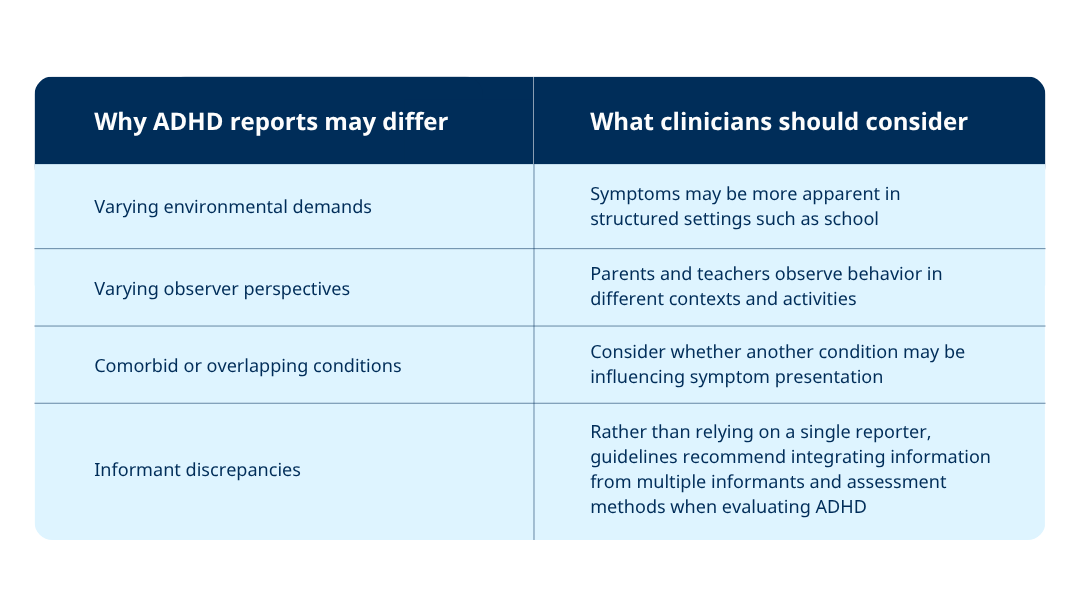
What's interesting is that even within each subtype, symptoms rarely present consistently. ADHD symptoms may appear different across settings. Environmental demands, observer perspectives, masking strategies, and comorbidities influence how patients express and report symptoms.
Evidence note: This summary is based on established findings in ADHD diagnostic guidance and research literature, including DSM-5-TR criteria, NICE ADHD guidance, and peer-reviewed studies on multi-informant agreement and contextual variation in symptom presentation.
Why do symptoms appear different at home vs at school?
There can be very different expectations for children between school and home. In education, children may experience stress, expectations to sit still and pay attention, academic pressure, and struggles with emotional dysregulation or rejection sensitivity. Home environments may be less structured, with fewer pressures and expectations.
Differences may also occur with the observer. Teachers see children in a comparative environment, alongside other students. Parents see children in smaller family groups and undertaking a wide range of activities through the week. Parental physical and mental health can also be significant in how a child’s developmental history is reported, including whether parents themselves have ADHD (diagnosed or undiagnosed).
What to do when parent and teacher ADHD reports disagree?
It’s quite common for parent and teacher reports on ADHD symptoms to vary. Introducing a multimodal ADHD assessment, including an objective test, into your workflow could provide greater clarity in complex or conflicting cases.
What symptom variability means clinically
Where differences are observed between settings, it’s important to understand why. An ADHD diagnosis using DSM-5 or ICD-11 requires symptoms to be present in multiple settings. If symptoms are present only in one setting, you will need to consider whether this is due to a specific environmental trigger (which may suggest context-driven behavior rather than ADHD) or whether responder bias or a compensation strategy is masking symptoms in some settings.
Clinical takeaway – ADHD symptoms can vary by setting. Understanding why is critical to making a differential diagnosis and distinguishing ADHD from context-driven behavior.
Subjective methods in ADHD care
Subjective measures are used widely in the assessment of ADHD, so it’s important to understand their strengths and weaknesses. Some examples of ADHD subjective assessment measures include rating scales, clinical interviews, parent, patient, and teacher feedback, school observations, and self-reports.
The data from subjective measures can help you assess whether there is any evidence of ADHD symptoms, and if so, how they may impact everyday functioning.
Strengths and limitations of rating scales
Clinicians use rating scales to collect information from the individual and from observers such as parents, teachers, or partners. Rating scales are an established element of an ADHD assessment test, and many clinicians and educators are familiar with their use. Rating scales are highly repeatable and can be useful for comparing symptom change over time or after commencing medication.
There are also some challenges introduced when assessing ADHD using rating scales and other subjective measures. Incomplete or unreturned rating scales, missing developmental history, responder bias, recall bias, and difficulties in self-evaluating symptoms can allow assessment subjectivity to compromise clinical judgement.
Clinical takeaway – Rating scales and other subjective measures are used to capture information on ADHD symptoms and effects, but can be vulnerable to responder bias.
Differential diagnosis and comorbidity considerations
ADHD can be difficult to differentiate from other conditions, and several factors can make identifying symptom presentations more challenging.
ADHD and comorbidities
Comorbidities are common among ADHD patients, with substance use disorder (SUD), mood disorders, anxiety disorders, and personality disorders being the most common psychiatric comorbidities.
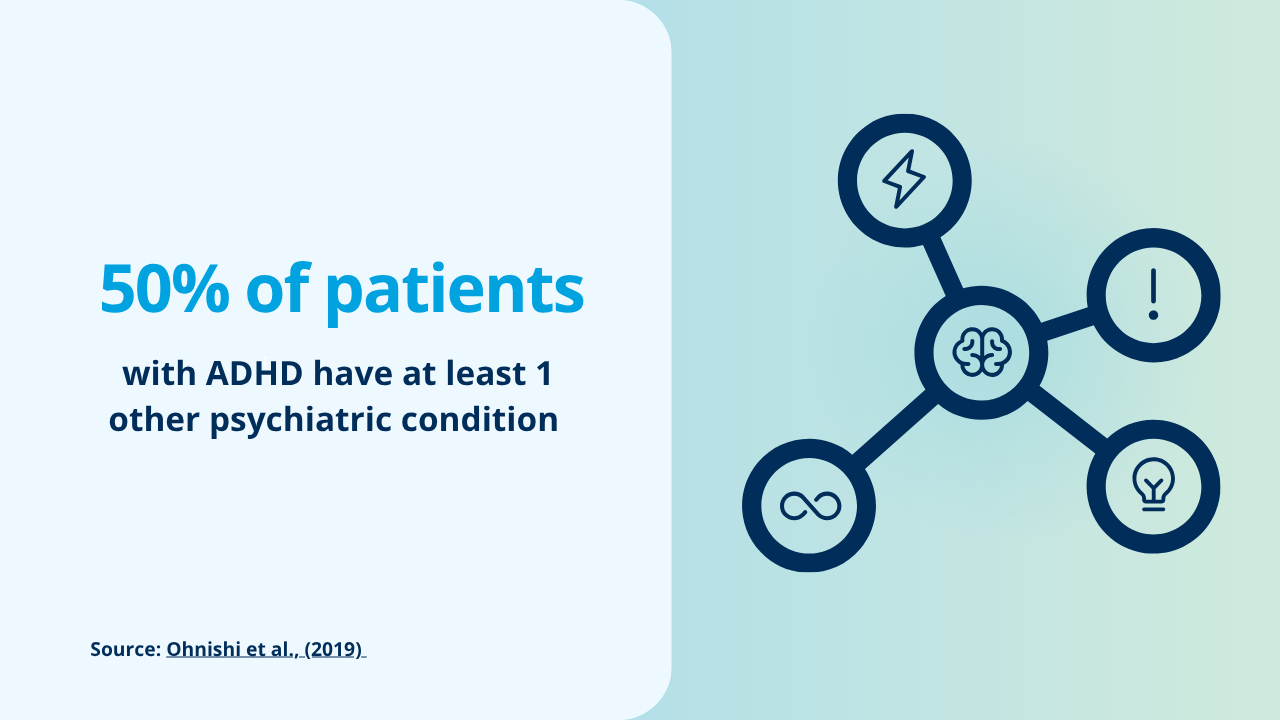
Sources: Ohnishi et al., (2019)
The presence of comorbidities can influence how symptoms appear, making diagnosis more challenging. There are also implications for selecting the right treatment response.
Find out more about the most frequently co-occurring comorbidities and what you need to know when diagnosing.
Reaching a differential diagnosis
As ADHD symptoms can overlap with several other conditions, patterns of how symptoms present can be more informative than simply whether symptoms are present or not.
Persistence can be a helpful indicator:
- Are symptoms present in multiple settings?
- Did symptoms onset during childhood?
- Are symptoms evident over time, rather than linked to specific times of stress, etc?
Read: Key questions to help differentiate ADHD from other conditions.
ADHD and gender differences
In the US, boys are almost twice as likely to be diagnosed with ADHD as girls.
More recent studies into ADHD have suggested sex at birth can influence ADHD symptom presentations. A pooled analysis of 52 studies examining sex differences in ADHD across more than 18,000 participants found that males showed significantly more severe hyperactivity/impulsivity symptoms across the lifespan. In contrast, several studies on females and ADHD have pointed to females exhibiting predominantly inattentive symptoms.
Explore: Differences in ADHD symptoms between females and males.
Masking and compensation strategies
People with ADHD can develop coping or masking strategies that help them manage their symptoms. If someone’s ADHD has gone undiagnosed for a long time, they may be more likely to have developed compensation strategies.
Women and girls also appear to develop more effective coping strategies than men and boys. However, this may contribute to the later diagnosis of ADHD in women, as these strategies can mask underlying difficulties and delay recognition of the condition. Women may be diagnosed with anxiety or another condition before ADHD is identified.
Coping strategies can become harder to maintain over time, and in periods of stress, may even collapse. This can make diagnosis challenging if masking obscured symptoms during childhood and no supporting developmental history is available.
Getting clarity in complex ADHD presentations
Watch our expert panel discuss comorbidities, overlapping ADHD symptoms, and how to get clarity in complex cases in our Rethinking ADHD podcast.
Clinical takeaway – Comorbidities, overlapping symptoms, differing gender presentations of ADHD, and coping and masking strategies can all make reaching a differential diagnosis more challenging and may require a more in-depth, multi-modal assessment.
Best practices for clinicians
Interpreting complex and conflicting cases
ADHD technologies and approaches to assessment have advanced significantly since researchers first recognized the condition. Revising your assessment workflow could help you when assessing complex and conflicting ADHD cases.
Using multimodal assessments in ADHD diagnosis
A multimodal ADHD assessment combines different methods of capturing information about a patient’s symptoms. This could include clinical interviews, rating scales, developmental history, patient/parent feedback, and an objective test.
Completing a multimodal assessment means you can cross-reference each assessment source to reduce subjectivity and identify inconsistencies. A multimodal assessment incorporating a digital ADHD test can also help you adopt a more consistent, evidence-based approach to ADHD care; an important consideration when diagnosing complex cases.
Read more: How multi-modal assessments help reduce diagnostic drift.
Clinical takeaway – Adopting a more holistic approach to ADHD care, including multimodal assessments and measurement-based care, could provide you with a more complete picture of symptoms for assessing complex cases.
How objective data can support ADHD diagnosis
A digital ADHD test can provide you with additional, objective data on ADHD symptoms to support your diagnostic decision-making.
How objective testing complements subjective reports
Using an objective test alongside your subjective measures can help you:
- Cross-validate results from each assessment source
- See if symptoms are evident under ADHD test conditions. This can help if results from subjective measures are inconclusive as to whether ADHD is present in more than one setting
- Gather quantitative data on symptoms where masking or compensation strategies may make subjective accounts less reliable
- Interpret ADHD symptom change over time using a consistent data set, comparing retest results with baseline data
QB testing has an accuracy of up to 89.5% in adults and 86.7% in children when combined with subjective measures. Using a digital ADHD test alongside subjective measures has reduced the time from assessment to final decision, and increased clinicians’ confidence in decision-making. This is done without compromising diagnostic accuracy.
How to integrate QB testing into clinical workflows
You can redesign your workflow to integrate QB testing. The Focus ADHD National Programme evaluation suggests that placing objective testing towards the start of a patient’s journey is beneficial. Results can be considered alongside subjective measures to inform diagnostic decision-making. This also establishes a baseline of symptom data for comparison after the patient commences medication, during titration, and as part of their long-term care.
With QB testing in your workflow, you could also consider introducing smarter triaging to help you allocate clinical resources more efficiently.
Read more: How to maximize ADHD service efficiency through smarter triage and workflow redesign
How to interpret QB testing reports and understand test data
After the patient completes their test, you will receive a report combining objective performance data with visual comparisons. The report comprises the following:
- ADHD total symptom score (TSS) – how closely results resemble typical ADHD symptom patterns
- Cardinal parameters – results for activity, inattention, and impulsivity benchmarked against an age and sex matched control group
- Time-based performance graphs – results broken down into quartiles to identify if symptoms worsen as the test progresses
- Visual comparisons – side-by-side comparisons to a benchmarked peer without ADHD
QB testing assessments also include the DSM-5 ADHD Symptom Checklist, and a rating scale completed by the patient (or a parent/teacher for children).
Read more: Interpreting objective ADHD test reports: Clinician tips
Clinical takeaway – The data from QB testing helps you compare your patient’s results with age and sex matched results of someone without ADHD to support diagnostic decision-making.
Frequently asked questions about ADHD frameworks (FAQs)
Why do parents and teachers disagree on ADHD symptoms?
Parent and teacher reports frequently differ because symptoms are observed in different environments and under different expectations. In an analysis of nearly 8,000 school children aged 4-17, parent and teacher reports often showed low agreement on hyperactivity and inattention symptoms.
How is developmental history used in diagnosing ADHD?
With early childhood onset being an important criterion in ADHD diagnosis using DSM-5 and ICD, developmental history can be a critical tool during assessment. If a child develops differently from their peers or does not meet expected developmental milestones, this may suggest a neurodevelopmental difference such as ADHD or Autism.
In our podcast, our experts also discuss whether parental and family history should be included when considering developmental history.
Watch now: ADHD clinical approaches: Gathering the developmental history.
How do clinicians distinguish between ADHD and Autism?
Reaching a differential diagnosis on autism vs ADHD often relies on interpreting subtle clinical nuances, e.g:
- Hyperactivity and impulsivity: In ADHD, this manifests as a need to 'get energy out.' In ASD, rocking or hand-flapping can be self-regulating techniques to manage overwhelm.
- Social reciprocity in conversation: Autistic patients may fixate on their own topics, while ADHD patients often shift between topics.
- Language understanding: Literal interpretations of conversation and metaphors could indicate the presence of autism, rather than ADHD.
Watch our expert clinician webinar: How to differentiate an ADHD and an ASD diagnosis.
How do hormones, perimenopause, and menopause affect ADHD symptoms in women?
There is growing evidence that falling estrogen levels may exacerbate ADHD symptoms in women. This can occur around the start of menstruation each month. A more sustained and significant impact is also seen during perimenopause and menopause, when estrogen and progesterone levels decline. ADHD symptoms may appear more severe at these times. The timing of ADHD assessments can become more important when symptoms fluctuate in this way.
Find out more: Women and ADHD: women’s health and hormones.
How reliable are patient self-reports of ADHD symptoms?
ADHD patients often struggle with self-evaluation. They may overestimate symptoms or miss the connection between symptoms and impairment. In particular, some patients may find assessing symptom improvement after treatment difficult. There is the risk of clinical judgment being compromised by the subjectivity of self-assessment. QB testing is more sensitive to medication effects than patient self-rating during follow-up visits.
Can digital ADHD tests be used remotely?
QbCheck can be used in suitable home environments with high reliability, facilitating use with telehealth and in hybrid and virtual clinics. Remote tests can make it easier for you and your patients to schedule appointments at convenient times, reducing travel time and making ADHD care more accessible, even in rural and remote areas.
Find out more about how the remote use of QbCheck works.
Can ADHD tests help guide medication titration decisions?
Digital ADHD tests like QbCheck can help clinicians monitor treatment effects and support dosage decisions, including in virtual and hybrid care settings. The data from QB testing supplements subjective feedback to provide you with quantifiable measures of medication effect. You can then adjust medication, titrating and retesting until the correct dose is achieved.
Download our ADHD titration checklist.