
Qbtech and Creyos both add quantitative data to ADHD assessments, but that’s where the similarities end.
Let’s explore the different approaches to ADHD assessment to help you decide which tool is the best fit for your clinic.
Disclaimer – This blog is for general information only, sourced from reputable and reliable references. It is not medical advice, nor should it be used as a substitute for professional guidance. Qbtech is not liable, and reader discretion is advised.
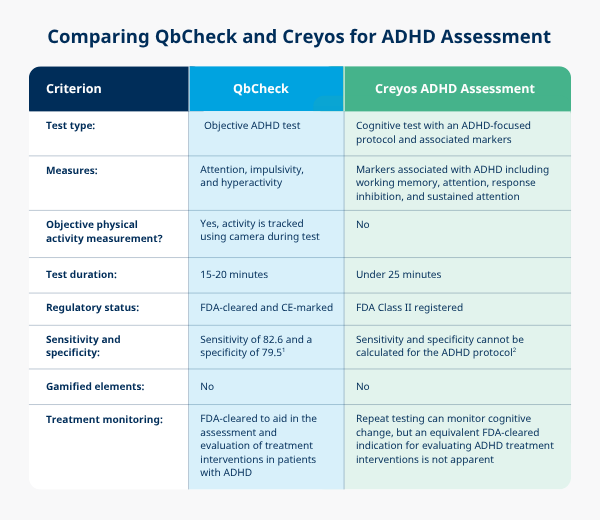
Comparing QbCheck and Creyos for ADHD Assessment
The following table is an overview of the different approaches to ADHD assessment by Qbtech and Creyos, with their respective ADHD technologies.
| Criterion | QbCheck | Creyos ADHD Assessment |
|---|---|---|
| Test type | Objective ADHD test | Cognitive test with an ADHD-focused protocol and associated markers |
| Measures | Attention, impulsivity, and hyperactivity | Markers associated with ADHD, including working memory, attention, response inhibition, and sustained attention |
| Objective physical activity measurement | Yes, activity is tracked using a camera during the test | No |
| Test duration | 15–20 minutes | Under 25 minutes |
| Regulatory status | FDA-cleared and CE-marked | FDA Class II registered |
| Sensitivity and specificity | Sensitivity of 82.6 and a specificity of 79.51 | Sensitivity and specificity cannot be calculated for the ADHD protocol2 |
| Gamified elements | No | Yes |
| Treatment monitoring | FDA-cleared to aid in the assessment and evaluation of treatment interventions in patients with ADHD | Repeat testing can monitor cognitive change, but an equivalent FDA-cleared indication for evaluating ADHD treatment interventions is not apparent |
Sources used:
- 1Ulberstad et al., (2020) Objective measurement of attention deficit hyperactivity disorder symptoms outside the clinic using the QbCheck: Reliability and validity
- 2Creyos ADHD Clinical Protocol and Report
- Creyos website
- Qbtech, FDA clears both QbTest and QbCheck
What is QB Testing, QbTest, and QbCheck?
QB testing refers to Qbtech’s objective approach to ADHD testing. It uses a computerized task designed to provide objective data on attention, activity, and impulsivity. QB testing can be carried out in-clinic with QbCheck or QbTest; QbCheck offers both in-clinic and remote functionality with the same clinical validity in either setting.
QbCheck and QbTest results are FDA-cleared, evidenced by supporting research, benchmarked against normative data, and results are presented visually, facilitating discussions with patients.
What is Creyos ADHD Assessment?
Formerly known as Cambridge Brain Sciences, the Creyos assessment combines age-appropriate questionnaires, 4 cognitive tasks, and the Sustained Attention to Response Task (SART). The tasks provide results for 14 cognitive markers associated with ADHD, covering planning, working memory, short-term attention, response inhibition, and sustained attention.
Unlike QbCheck, Creyos does not objectively measure activity, even though hyperactivity is one of the 3 core ADHD symptom domains.
The test can be administered in-clinic or remotely.
QbCheck vs. Creyos: What’s the Difference Between the Tests?
Here's an overview of the differences between QB testing and Creyos' ADHD test:
- QbCheck is an objective ADHD test measuring attention, activity, and impulsivity during a computerized task
- Creyos combines cognitive tasks and questionnaires to provide measures of markers that can be associated with ADHD, including working memory, attention, and response inhibition
- The two tools therefore provide different types of information and should not be treated as interchangeable assessments
Need help deciding between ADHD tests?
Our practical 12-question checklist helps you compare ADHD testing options and make an informed choice for your clinic. It takes only a couple of minutes.
Which ADHD Assessment Tool is Right for Your Clinic?
As mentioned above, QB testing and Creyos serve different purposes, but how do you choose between the two? Let's take a deep dive into the features of QbCheck and the Creyos ADHD test, so you can pick the best fit for your practice.
QbCheck provides measures of activity, attention, and impulsivity to aid clinical decision-making. Patient activity during the test is recorded using the computer’s camera. These measures are useful for clinicians when assessing ADHD, as they align with the 3 core symptoms of ADHD used by frameworks such as DSM-5 to make an ADHD diagnosis.
Creyos measures specific cognitive functions, including working memory, attention, response inhibition, and planning. This data can help identify areas of cognitive difficulty. However, these difficulties are not specific to ADHD, and patients with ADHD may perform within the typical range on some cognitive measures. This means cognitive results alone may not distinguish ADHD from other conditions or rule it out when results fall within the typical range.
Creyos’ own guidance indicates that some markers like planning deficits and working memory issues “are not defining features of ADHD” (from Creyos ADHD Clinical Protocol and Report). It also notes that planning deficits may be “context-dependent and inconsistent.” This limitation is supported by independent research. A study of 115 adolescents with ADHD concluded that “only a proportion of adolescents with ADHD shows planning deficits.”
Broader research into using cognitive testing approaches for ADHD assessment has highlighted further limitations of Creyos for ADHD assessment:
A study of 199 adults referred for ADHD assessment found similar cognitive profiles among those diagnosed with ADHD and the clinical comparison groups, suggesting that cognitive testing may have limited value in distinguishing ADHD from other psychiatric presentations.
The Creyos ADHD assessment also does not include an objective measure of activity.
What regulatory clearances does each ADHD assessment have?
QbCheck is FDA-cleared and CE-marked, demonstrating compliance with applicable regulatory requirements. NICE also recommends QbTest as an option to support ADHD diagnosis in children and young people aged 6–17. QbCheck has high clinical equivalence to QbTest across all 3 cardinal parameters.
Creyos states that the Creyos platform is registered with the FDA as a Class II medical device. Registration is not the same as FDA clearance.
“When a facility registers and lists its devices, the resulting entry in FDA’s registration and listing database does not denote approval, clearance or authorization of that facility or its medical devices.”
How is the accuracy of each ADHD test evidenced?
Published studies, clinical research, and real-world evidence can help clinicians assess whether an ADHD test performs as claimed. Over 50 clinical studies have been published on the use of QB testing to support ADHD assessment and treatment.
Sensitivity and specificity are measures used in research to evaluate how accurately a test distinguishes between people with and without a condition. When applied to ADHD testing:
- Sensitivity is the proportion of people with ADHD who are correctly identified by the test
- Specificity is the proportion of people without ADHD who are correctly identified as not having it
QbCheck has shown high test–retest reliability and discriminated well between patients with ADHD and controls. A sensitivity of 82.6 and a specificity of 79.5 were recorded.
Creyos, on the other hand, states that sensitivity and specificity cannot be calculated for its ADHD protocol (Creyos ADHD Clinical Protocol and Report) because it does not provide diagnostic cutoffs for the presence or absence of ADHD.
Why does this matter? Because when diagnosing ADHD, clinician confidence in testing technologies is critical. Supporting evidence, including reliability, validity, clinical utility, and sensitivity and specificity, should be considered carefully when selecting a test for your clinic.
Can ADHD Tools Support Treatment Monitoring?
Repeating either test can provide data that can be compared with baseline results to compare change before and after treatment. However, only QbCheck is FDA-cleared for evaluation of treatment interventions.
QbCheck has demonstrated statistically significant improvements in Total Symptom Scores by 46.28% when assessing symptoms after treatment initiation.
Repeating the cognitive tasks within the Creyos assessment can help monitor changes in cognitive performance over time, providing additional information about the wider effects of treatment. However, a systematic review focused on children with ADHD concluded that changes in neurocognitive performance should not be used as a proxy for changes in clinical ADHD symptoms. Improved working memory or planning, for example, does not necessarily indicate an equivalent improvement in core symptoms. The accompanying questionnaires can help track reported symptoms, but these provide subjective rather than objective measures.
What QbCheck tells clinicians
QbCheck can provide:
- Objective measures of inattention, hyperactivity, and impulsivity
- Visual results benchmarked against normative data from people of the same age and sex at birth
- Data on changes in ADHD symptom measures over time and following medication, using repeat testing
QbCheck cannot diagnose ADHD on its own but is intended to be used alongside other assessment methods, such as clinical interviews and rating scales.
What Creyos tells clinicians
Creyos can provide:
- Objective measures of 14 cognitive markers associated with ADHD, including attention, working memory, planning, and response inhibition
- Results for those cognitive markers compared with normative data
- Repeated cognitive measurements to help clinicians assess changes in performance on those specific markers over time
Creyos cannot provide:
- An ADHD diagnosis on its own
- Objective measures of physical activity or motor hyperactivity during testing
- Confirmation that difficulties with planning, working memory, or other cognitive functions are caused by ADHD
Can Gamification Influence ADHD Test Results?
Using gamified elements in ADHD tests has raised concerns about the reliability of results. They may influence how patients perform during testing and make it harder to accurately measure ADHD symptoms.
“Recent research suggests that gamification may not be the best approach for assessment.”
Gamification may affect test-takers’ performance differently according to their age, ADHD symptom levels, and responsiveness to rewards, and may “hinder the assessment properties of a task.”
QbCheck contains no gamified testing elements.
Choose the Right ADHD Test for Your Clinic
QbCheck and the Creyos ADHD assessment tool are quantitative tests that assess ADHD, each adopting a different approach to the testing process. QbCheck objectively measures attention, activity, and impulsivity, which correspond to the 3 core symptoms of ADHD. Creyos measures 14 cognitive markers associated with ADHD using a gamified platform.
The products also differ in their regulatory status, measurement approach, and the types of diagnostic-accuracy evidence available for the complete product.
For a detailed comparison of the strengths and weaknesses of subjective, objective, and cognitive ADHD assessments, explore our blog on choosing the right ADHD test.