


Objective testing technologies, wearable devices, and AI integration tools can provide valuable information for ADHD care delivery. But how can you incorporate technology without compromising clinical judgment?
In this blog, we explore how you can keep clinical expertise at the center of decision-making while integrating technology at the right junctions.
What Role Can Technology Play in Clinical Decision-Making?
Technology already plays an important role in modern health care and ADHD workflows. From wearables that track activity to AI tools that analyze patient information and objective ADHD tests that measure attention, activity, and impulsivity, technology is helping clinicians better understand symptoms, monitor patients, and make informed decisions.
| NICE recommends QbTest as an option to help diagnose ADHD in children and young people aged 6–171 | 50% of surveyed clinicians think AI is improving patient care today2 | 76% of UK NHS staff and 54% of the UK public support the use of technology (AI) in patient care3 |
| The global ADHD apps market is projected to grow from $2.2 billion in 2026 to $6.7 billion by 2033, an average annual growth rate of 17.5%4 | A study of 139 US mental health clinicians found that 83.4% believed digital data could improve their clinical practice5 | 80% of surveyed clinicians predict AI will be a critical assistant in 5–10 years2 |
“Any use of AI methods should be based on the principle of augmentation, not replacement, of human involvement (that is, having a capable and informed human in the loop).”
In the field of ADHD assessment and diagnosis, standardized, objective data from QB testing can help you build a more complete picture of symptoms. It can also mitigate some of the risks of rating scales and clinical interviews, such as responder bias, incomplete or inconsistent responses, and an overreliance on patient or informant recall.
How Can Technology Improve Patient-Clinician Communication in ADHD Clinics?
Helping patients understand their ADHD symptoms and impairments can encourage them to take a more active role in their treatment, symptom monitoring, and management of ADHD.
Digital tools like QbCheck can help patients better understand ADHD symptoms. Test results are presented visually, helping clinicians show how test performance compares with age- and sex-matched normative data. This can support patient-clinician communication and shared decision-making.
“We've had a 100% hit rate with parents being really happy. It clears up a lot of frustration for them. I literally had parents saying, ‘Can I screenshot this graph?’ Like they were mind blown from just like the visual depiction in the interpreter's report of this is how severe your kid’s ADHD is, or this is where the lever is for inattentiveness or hyperactive impulsivity type.”
Technology can also support ADHD psychoeducation through chatbots, online learning modules, or smartphone apps. AI can help tailor educational content to a patient's level of understanding and preferences, adapting it in response to feedback.
For ADHD resources you can share with patients and family members, access our psychoeducation toolkit below.
How Can Technology Support Continuity of Care for ADHD Patients?
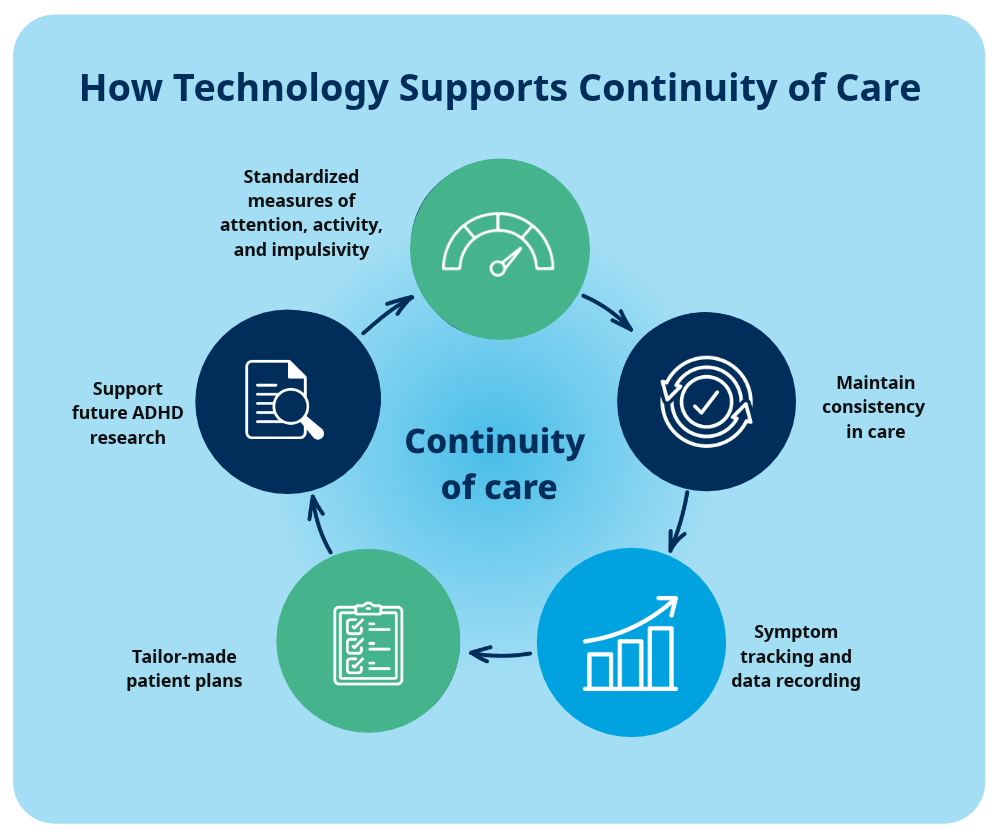
Digital technologies can offer several benefits for ongoing ADHD care.
- Repeated digital ADHD testing with tools like QbCheck provides standardized measures of attention, activity, and impulsivity to help monitor changes in response to treatment over time
- Digital health records help maintain consistency when patients move between clinics or see different healthcare professionals
- Wearable devices like smartwatches and fitness monitors can help with symptom tracking and data recording between appointments
- Telehealth combined with remote ADHD testing can offer greater flexibility when scheduling appointments and improve access to care
- Large datasets can also support ADHD research and improve our understanding of the condition. For example, more than 1 million patients worldwide have completed QB testing, contributing to a growing body of real-world data.
Why Does Clinical Judgment Remain Essential in ADHD Care?
Technology can capture and analyze ADHD symptom data to support diagnostic decisions. However, clinicians remain responsible for interpreting that information and making the final diagnosis. This is why clinician judgment remains essential, even as technology improves.
ADHD Patient Data May Not Tell the Whole Story
Masking and coping strategies can mean that the information initially available about a patient's ADHD symptoms does not reflect the full extent of their difficulties. A patient may appear to be coping well based on their achievements at school or work. However, clinical interviews may reveal that it takes considerable additional effort, suggesting they may be compensating for underlying ADHD symptoms. These conversations can uncover difficulties that might otherwise be missed, highlighting the importance of the patient-clinician relationship.
Context, Patient History, and Additional Observations Add Insights
No single dataset or test can be used to diagnose ADHD. Instead, clinicians review and interpret findings from multiple sources, including test results, rating scales, medical and developmental history, and patient and parent feedback.
Both quantitative data and clinical observations can then inform diagnostic decisions.
Diagnosing ADHD is About More Than the Presence or Absence of Symptoms
While identifying symptoms is important when diagnosing ADHD, clinicians must also consider the impact those symptoms have on a patient's daily life and ability to function. This requires an understanding of the patient's individual circumstances, including factors that may be more difficult to measure. Clinicians will also consider whether treatment options may benefit the patient, what support systems are in place, and how a diagnosis may affect them. These decisions require clinical judgment and empathy that technology cannot independently provide.
Can AI and Technology Replace Clinical Judgment?
Short answer: No. Technology, including AI, can be effective when analyzing information, identifying patterns, and reducing administrative tasks. However, it cannot replace human empathy or the clinical judgment needed to make informed care decisions.
The American Medical Association (AMA) and NICE have both emphasized the importance of maintaining human oversight when using AI in health care.
“Clinical decisions influenced by AI must be made with specified qualified human intervention points during the decision-making process. A qualified human is defined as a licensed physician with the necessary qualifications and training to independently provide the same medical service without the aid of AI.”
What Should Clinicians Look for When Choosing Digital Health Technology?
Several important factors should be considered when introducing a new ADHD testing tool or digital technology into your workflow.
For medical devices, FDA clearance in the US and CE marking or MHRA registration in the UK can help demonstrate that a device meets relevant regulatory requirements.
Also consider:
- Evidence and reliability – is there clinical evidence demonstrating that the technology performs reliably and as intended?
- Clinical integration – will the technology complement or advance your existing ADHD workflow, and meet your patients’ and clinic’s needs?
- Clinical oversight – does the technology provide useful information while allowing you to interpret findings and retain control over care decisions?
Technology and Clinical Expertise Working Together for Better ADHD Care
Digital technologies can provide standardized, consistent information on ADHD symptoms, helping clinicians make more confident diagnostic decisions. However, technology cannot replace the clinical expertise needed to interpret this information or the trust, empathy, and understanding that underpin strong patient-clinician relationships.
The greatest value for patients comes from combining technology with clinical expertise to deliver informed, personalized ADHD care.