

This year, mental health practices will continue to face high demand for evaluations. In the US, ADHD and Autism clinics market is expected to reach $115.55 billion by 2030. Even established clinical workflows can struggle to keep up with referral volumes and patient expectations like these.
To meet these challenges and continue delivering high-quality, equitable care, clinic models must adapt. Future-proofing an ADHD service means building sustainable systems that are scalable, integrated, inclusive, and capable of operating across hybrid models of care.
We've outlined practical steps to build a future-ready ADHD clinical workflow. Whether you’re reviewing an existing service or planning growth, this blog provides you with the clinical insights, tools, and frameworks needed to develop evidence-led, robust, and scalable clinical workflows.
Content
What a modern ADHD clinic looks like
Clinicians speak about the future of ADHD care
An ADHD care model built for real clinical settings
Practical steps to optimize clinical outcomes
Clinician resources: everything you need to build a future-ready ADHD clinic
FAQs: Clinician questions answered
How objective technology is powering the next generation of ADHD clinics
ADHD trends to watch in 2026
From data-driven testing to hybrid care models and collaborative workflows, staying ahead of these ADHD trends is key to delivering high-quality, scalable, patient-centered services.
#1 The prominence of digital ADHD testing and hybrid care
Patient expectations and the need for clinical efficiency will continue to drive further adoption of digital ADHD testing, including the development of mobile-based ADHD tests. In addition to improving care equity, hybrid models offer benefits to clinicians, such as opportunities for clinic expansion and more efficient operations.
#2 Personalized ADHD care for everyone
ADHD care is becoming more personalized and patient-centered, supporting clinicians to treat the individual and all comorbid conditions holistically. These changes are reflected in a move towards more patient-centered goals that track improvements to quality-of-life, such as better school or work performance, improved self-regulation, etc.
#3 Integrated ADHD care between primary and specialist teams
Shared care models, supported by collaborative digital information platforms, allow clinics to work seamlessly with schools, primary care, and specialists. This multidisciplinary approach supports continuity of care, with less disruption at key life transitions, and greater capacity for assessing complex cases.
Learn more about the key trends shaping ADHD care in 2026 and what they mean for clinicians building future-proof clinics
What does a modern ADHD clinic look like?
The ADHD clinics that embrace technology, develop robust and resilient models of care, and adapt to deliver hybrid care models will thrive in 2026 and beyond.
Digital tools for efficient ADHD management
Technology can help clinicians improve patient care and optimize clinic performance. Digital ADHD tests can increase clinician confidence, facilitate ADHD medication titration, and increase patient trust in clinician decisions.
Remote and hybrid models of care are shaping the future of ADHD service delivery. Virtual ADHD services offer a platform for clinic expansion across geographic boundaries and help minimize patient travel time and costs.
Technology that enhances, not replaces, clinical judgement
Some clinicians worry that future ADHD clinics may reduce opportunities for direct clinician–patient interaction. In practice, digital tools can support more accessible, inclusive, and meaningful care. We see future-ready ADHD clinics using technology to further empower patients and place them firmly at the center of their care. Here’s how:
- The greater accessibility of hybrid ADHD services leads to more equitable care for all, reducing geographic disparities
- Digital psychoeducation resources empower patients, increasing their understanding of ADHD and how to manage symptoms
- The results from digital ADHD tests provide patients and clinicians with a visual representation of symptoms improving patient experience
Is your clinic future-ready? Read more on the ADHD clinics of 2026 and beyond
Clinicians speak – The future of ADHD care
The successful ADHD clinics of the future are built on the lessons of today. In this video, clinicians share what they believe needs to change in ADHD services, and where clinics must adapt to meet the demands of 2026 and beyond.
For clinicians, the goal is clarity: a clinic model that supports accurate identification without unnecessary delays, offering the best to its patients.
An ADHD care model built for real clinical settings
An ADHD clinic is only as effective as the workflow that supports it. Your clinical workflow impacts diagnosis time, patient experience, clinician workload, and your clinic’s ability to scale sustainably. The difference between an ADHD clinic delivering care consistently and one under strain will often come down to how well its patient pathway is designed.
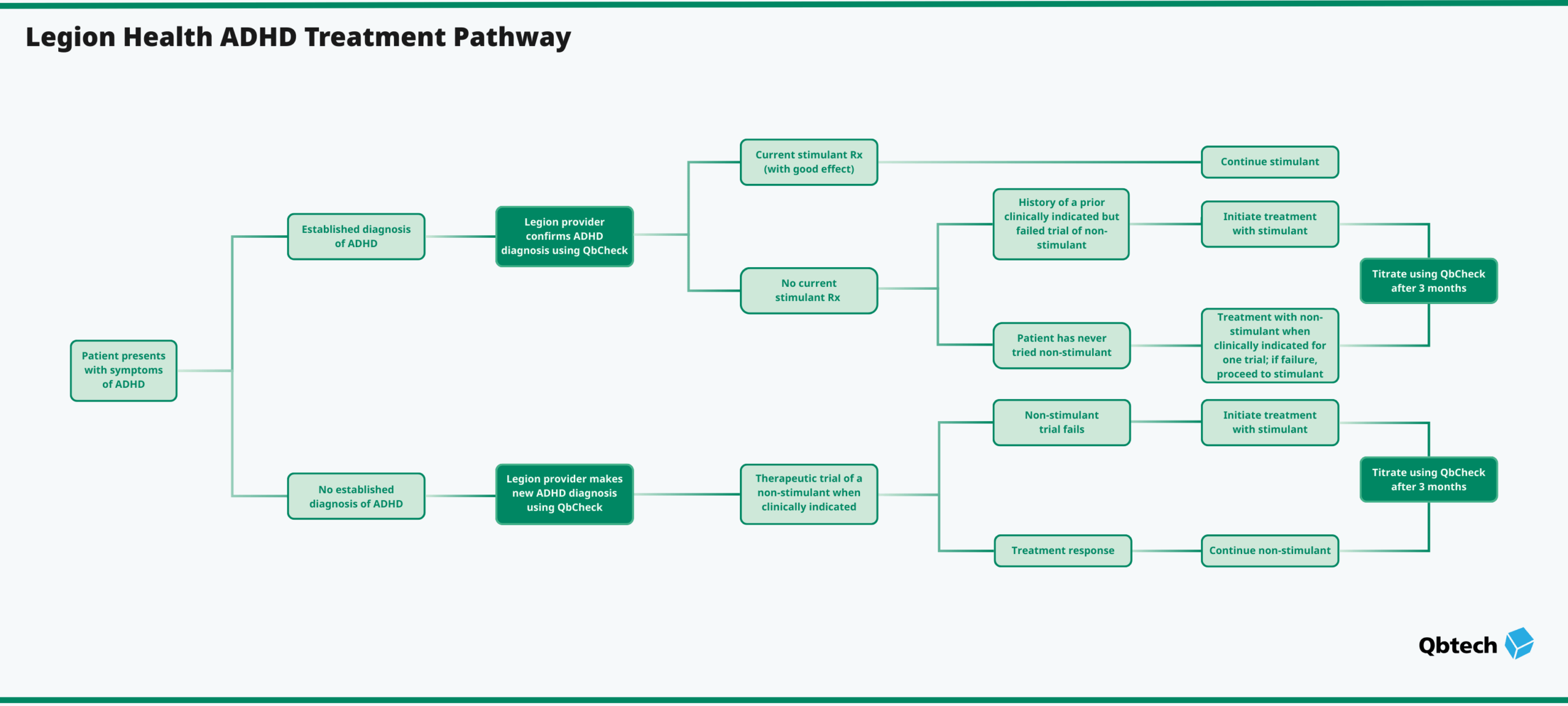
From referral through assessment, diagnosis, titration, and ongoing support, each step of the journey should be clear, efficient, evidence-led, and centered on patient need. The workflow model above illustrates what effective ADHD care should look like. Clear, structured steps can support timely diagnosis, consistent care, and sustainable service delivery.
Best practices and common pitfalls
An effective ADHD model:
✅ Combines subjective and objective data to support clinical decisions
✅ Is patient-centered, ensuring high-quality care and understanding
✅ Supports hybrid delivery with flexible scheduling that benefits patients and clinicians
✅ Promotes tailored treatment plans for patients
✅ Integrates smoothly with primary care, schools, and other services where shared care is needed
An ADHD model that isn’t delivering, often:
❌ Considers assessment, titration, and follow-up as disconnected steps
❌ Treats ADHD in isolation, rather than looking at the complete picture
❌ Is admin-intensive with process gaps
❌ Is inconsistently implemented across the operational workflow
❌ Is inflexible, limiting potential to adapt patient care models mid-journey
Practical steps to optimize clinical outcomes
Effective care places patients at its center while empowering clinicians with the right tools and insights. Clinics can operate more efficiently and support more patients. It also enables closer collaboration with other care providers and the wider community, helping advocate for better outcomes for people with ADHD.
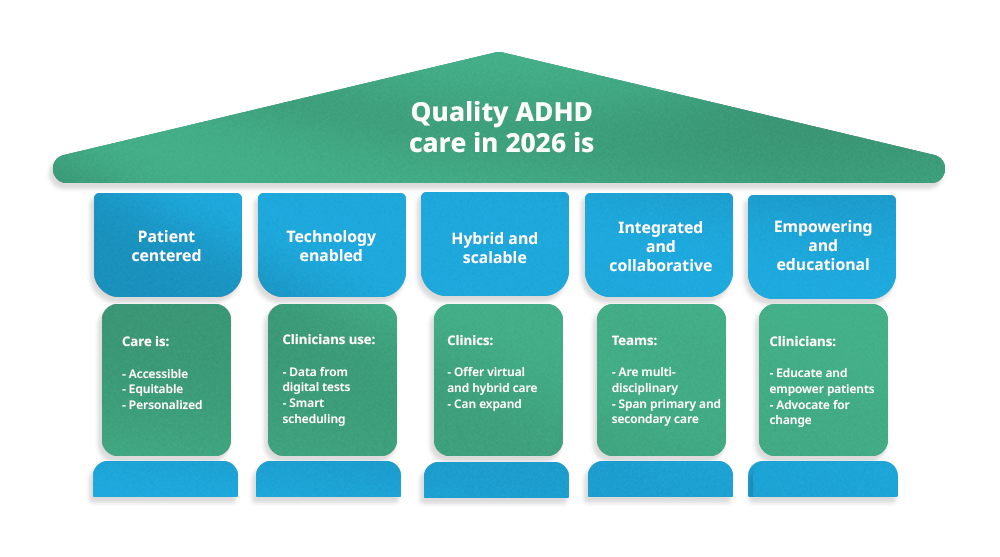
Want to start delivering higher quality ADHD care?
These practical steps can help you move towards a future-ready ADHD clinic –
#1 Review your ADHD clinic’s workflow
Critically analyzing your existing clinical workflow for ADHD care can help you identify inefficiencies, gaps in provision, bottlenecks, opportunities to collaborate with other teams, and where improvements are possible.
#2 Adopt technologies that will benefit your patients and ADHD clinic’s operational efficiency
Incorporating new technologies into your clinic can significantly improve clinician diagnostic confidence and patient understanding of ADHD. Clinic operational efficiency can also be increased with optimized appointment scheduling and reduced administration.
#3 Start collecting data on your ADHD clinic and patients today
Data is a key tool supporting the ADHD clinics of the future. Tracking clinical, operational, and patient metrics will help your clinic identify areas for improvement and quantify the quality of care provided.
Our guide on how to integrate an objective ADHD test has helpful insights on reviewing workflows and what stages to integrate objective tests
Metrics to track in an ADHD clinic in 2026
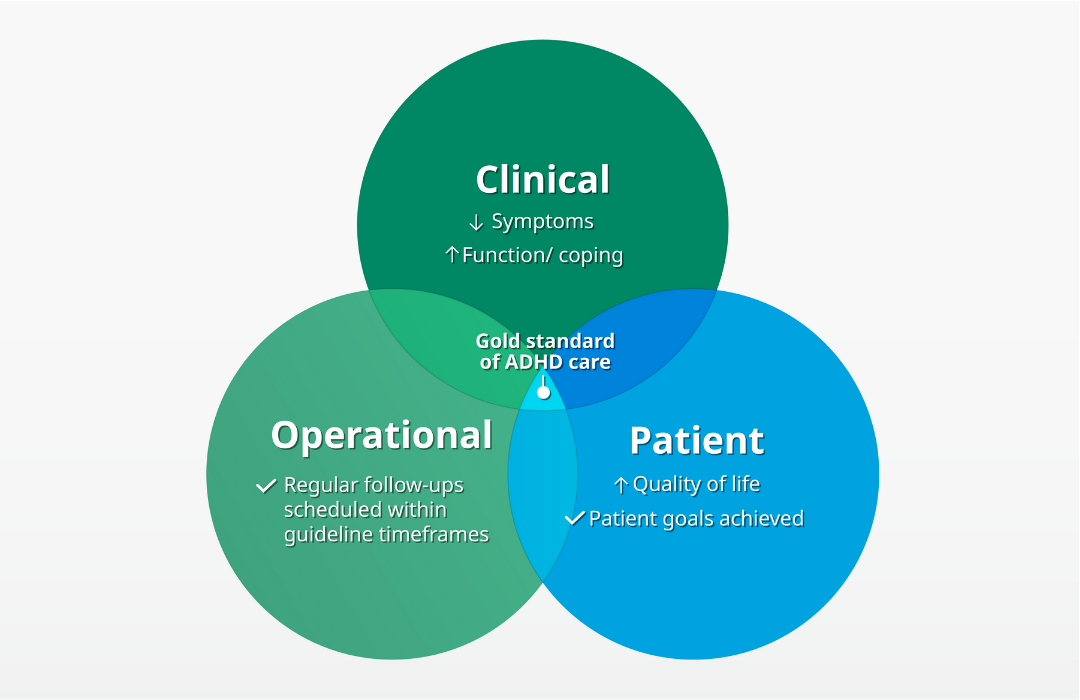
There are three core areas for ADHD success metrics: clinical outcomes, operational outcomes, and patient-centered outcomes. Consistently meeting goals across these areas will lead to continuous improvement and better care outcomes. Having a checklist to help track quality care delivery can help you operate at maximum efficiency.
Clinician resources for effective ADHD management
We’ve brought together practical tools and guidance so you can build an efficient, effective, and future-ready ADHD clinic.
Patient resources and ADHD management
Helping you diagnose ADHD and support patients to understand, manage, and thrive in their ADHD journey.
- ADHD in complex cases – Get answers to FAQs on diagnosing and treating patients with comorbidities and complex presentations
- Ultimate ADHD titration checklists for clinicians – Follow our step-by-step guide to titrating ADHD medication in virtual and hybrid clinics
- Better conversations = better care psychoeducation toolkit – Download our comprehensive toolkit to help patients manage and understand ADHD with handouts, conversation frameworks, checklists, and posters
- How to differentiate an ADHD and an ASD diagnosis – Watch our webinar on overlapping symptoms, diagnostic challenges, and strategies for accurate differentiation of ADHD and ASD
- Helping teachers understand ADHD - A resource toolkit aimed at teachers that you can use in community and outreach work, or when supporting younger patients
Clinic and operational resources
Helping you deliver ADHD care efficiently and adopt technology-enabled, scalable, and hybrid models of care.
- What does a hybrid ADHD care model look like? – Explore how ADHD care can be delivered safely and effectively in hybrid clinics
- ADHD metrics every clinic should track – Use our checklist to ensure your clinic is tracking essential patient, operational, and clinical metrics
- How effective is your ADHD clinical workflow? – In just 2 minutes, see how your ADHD practice compares with top-performing clinics and get a personalized report
- Marketing ADHD services to patients - A guide to branding and communications for clinicians
FAQs by ADHD clinicians answered
1. What should a modern ADHD assessment workflow look like?
A modern ADHD assessment workflow is a combination of positive patient experience, use of evidence-based data, streamlined structure, and a consistent, scalable model. Introducing digital ADHD technologies to your workflow can act as a unifying point of reference or central anchor to connect these elements.
2. How can we reliably differentiate ADHD from anxiety, trauma, sleep issues, or depression in adults?
Many conditions have overlapping symptoms with ADHD. For a reliable diagnosis, it is important to focus on developmental onset, symptom persistence, and functional impairment over time. This can be a critical factor in differentiating ADHD from conditions such as anxiety, trauma, or depression, which may have developed later in life.
Adapting clinical interviews to ask more open-ended questions about daily routines can help to reveal symptoms that patients may be unaware of. Objective data can also help clinicians make a diagnosis in these complex cases.
3. How to adopt hybrid models of care safely?
Safe hybrid ADHD care relies on clearly defined workflows that specify which steps can be completed remotely, and where in-person visits add value. Validated digital tools, standardized protocols, and careful documentation of data are key to maintaining clinical quality of care.
Parts of the ADHD care journey, such as diagnosis, titration, and routine check-ins, are well-positioned for delivery in a hybrid model.
4. How do I explain ADHD results more clearly to patients?
The results from an ADHD test can be an effective tool for helping patients understand their ADHD symptoms and diagnosis. The QbCheck reports, for example, are highly visual, and clinicians can use them to facilitate conversations with patients and aid understanding.
Psychoeducation is also a useful tool to explain a diagnosis. Educational resources help patients understand their results in the context of ADHD as a condition and how it affects people.
5. How can I manage rising ADHD referrals without burning out the team?
Managing increased demand starts with streamlining workflows. Clear role allocation across the care team also helps protect capacity and reduce burnout. The National Institute for Health and Care Excellence (NICE) recommends a multi-disciplinary approach to ADHD care.
In the UK, nurse practitioners have been able to take ADHD cases from stretched psychiatry team members by using objective data to help them complete assessments promptly and with increased confidence.
6. How do I make ADHD diagnosis more consistent across my team?
ADHD clinics should establish a clear workflow for ADHD assessment, titration, and long-term care. Using the same rating scales, a consistent approach to clinical interviews, and using objective testing can help ensure consistency. All patients will have the same quality experience in your clinic. Regular check-ins and shared learning further support diagnostic confidence across teams.
7. What objective tools actually help with ADHD diagnosis?
Objective tests like QbCheck measure the three core symptoms of ADHD (inattention, impulsivity, and hyperactivity) in a standardized way. When used alongside subjective measures, they help diagnose ADHD with greater confidence and with quicker, more accurate evaluations.
The most effective tools are evidence-based, validated, and easy to integrate into existing workflows. When choosing, it’s important to find tools that are FDA-cleared for use in the US and CE-marked and registered with the MHRA if using them in the UK. Taking these steps can help to protect both you (legally and reputationally) and your patients.
8. What are the limitations of objective ADHD tests?
Objective tests should not be used to diagnose ADHD on their own. They are intended for use alongside subjective measures such as rating scales and clinical interviews.
Some objective tests may not be suitable for the youngest and oldest patients. As an example, QbCheck is only intended for patients aged 6-60.
They capture specific cognitive and behavioral patterns but do not account for context, comorbidities, or patient history. Their strength lies in complementing, not substituting, comprehensive clinical assessment.
9. How can we make ADHD services scalable and accessible?
Scalable ADHD services successfully balance standardization with flexibility. Using digital tools and technologies can help clinics expand their services and improve patient accessibility. This will also reduce travel time and support patients in underserved areas access quality care.
10. How can I prepare now for future ADHD care demands?
Developing successful ADHD care models involves the use of technology like online appointment scheduling, objective testing, and telehealth to maximize efficiencies and increase clinical capacity. Adopting multidisciplinary team approaches and forging greater links between primary and secondary care ADHD services can reduce pressure on clinical staff.
How objective technology is powering the next generation of ADHD clinics
Our goal has always been to support clinicians and ADHD patients through objective data and insights. We recognize that building a future-ready ADHD clinic in 2026 and beyond means adopting the right tools today. That’s why we continue to invest in research and digital tools for clinicians. They help streamline ADHD assessments, establish remote-friendly workflows, and deliver high-quality care at scale.
By embracing innovative technologies and placing patients at the center of care, you can set your clinic on a path to long-term success.