

There isn’t a single global standard or criterion for ADHD diagnosis. However, DSM-5, ICD-11, and NICE are the most widely followed guidelines. This blog explores the similarities and differences between each framework. We’ll outline what they say about symptom interpretation and how this affects ADHD diagnosis thresholds. That way, you can decide which framework is right for you and your patients.
Table of contents
How is ADHD diagnosed globally?
Why are there different frameworks for diagnosing ADHD?
DSM-5 vs ICD-11 vs NICE: Comparing ADHD diagnostic guidelines
What is the DSM-5 ADHD criteria?
How does ICD-11 diagnose ADHD?
What does NICE recommend for ADHD diagnosis?
Clinical best practices for ADHD assessments
How is ADHD diagnosed globally?
ADHD diagnosis is guided by established systems that define symptom thresholds, functional impairment, and developmental onset, amongst other things, while allowing room for clinical judgement. In practice, you typically integrate these frameworks with multimodal reports and data sources, including clinical interviews and objective tests, to arrive at standardized yet individualized decisions.
Using guidelines from the DSM-5 (American Psychiatric Association) or the ICD-11 (World Health Organization), for example, helps ensure your patients are appropriately diagnosed and treated for ADHD.
Why do different ADHD frameworks exist globally?
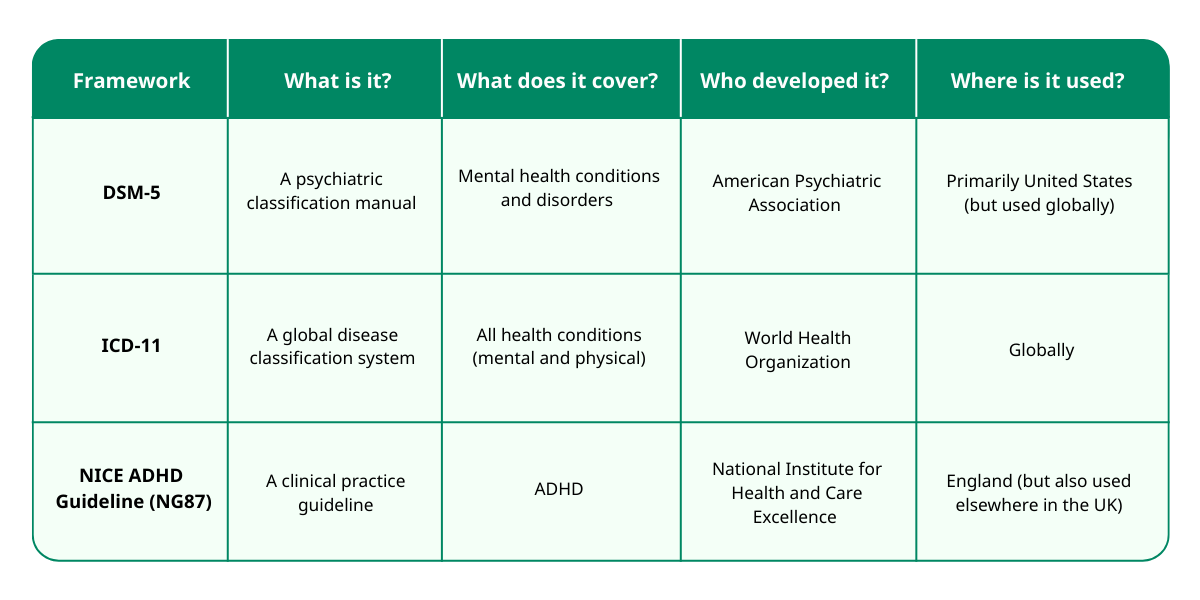
Owing to the difference in cultural interpretations of behaviours, localized medical practices and diagnostic standards, there are multiple diagnostic frameworks for ADHD management. DSM-5, ICD-11, and NICE ADHD guidelines serve slightly different purposes and were developed by different organizations for use in different geographies.
DSM-5
DSM-5 defines mental health disorders with criteria to aid consistent diagnosis. It was developed by the American Psychiatric Association for use in the United States, but is used globally.
ICD-11
ICD-11 covers all health conditions and was developed by the World Health Organization. It’s used internationally as a standardized disease classification and diagnosis framework.
NICE guideline
NICE guideline NG87 is specific to ADHD. It was developed for use in England by the National Institute for Health and Care Excellence. However, it is used in other parts of the UK too. It’s a clinical practice guideline, so it covers assessment, diagnosis, and management of ADHD, with a focus on service delivery.
DSM-5 and ICD-11 define what ADHD is, whereas NICE NG87 is more concerned with the care pathway for ADHD. Which you use in your clinic will often depend on which country you are based in, and whether you’re looking for guidance on diagnosis or patient care.
Learn how clinically validated technology for ADHD testing helps you in day-to-day practice.
DSM-5 vs ICD-11 vs NICE
Comparing ADHD diagnostic guidelines
If you’re considering which framework is best suited to support you in diagnosing ADHD, this table summarizes the key similarities and differences.
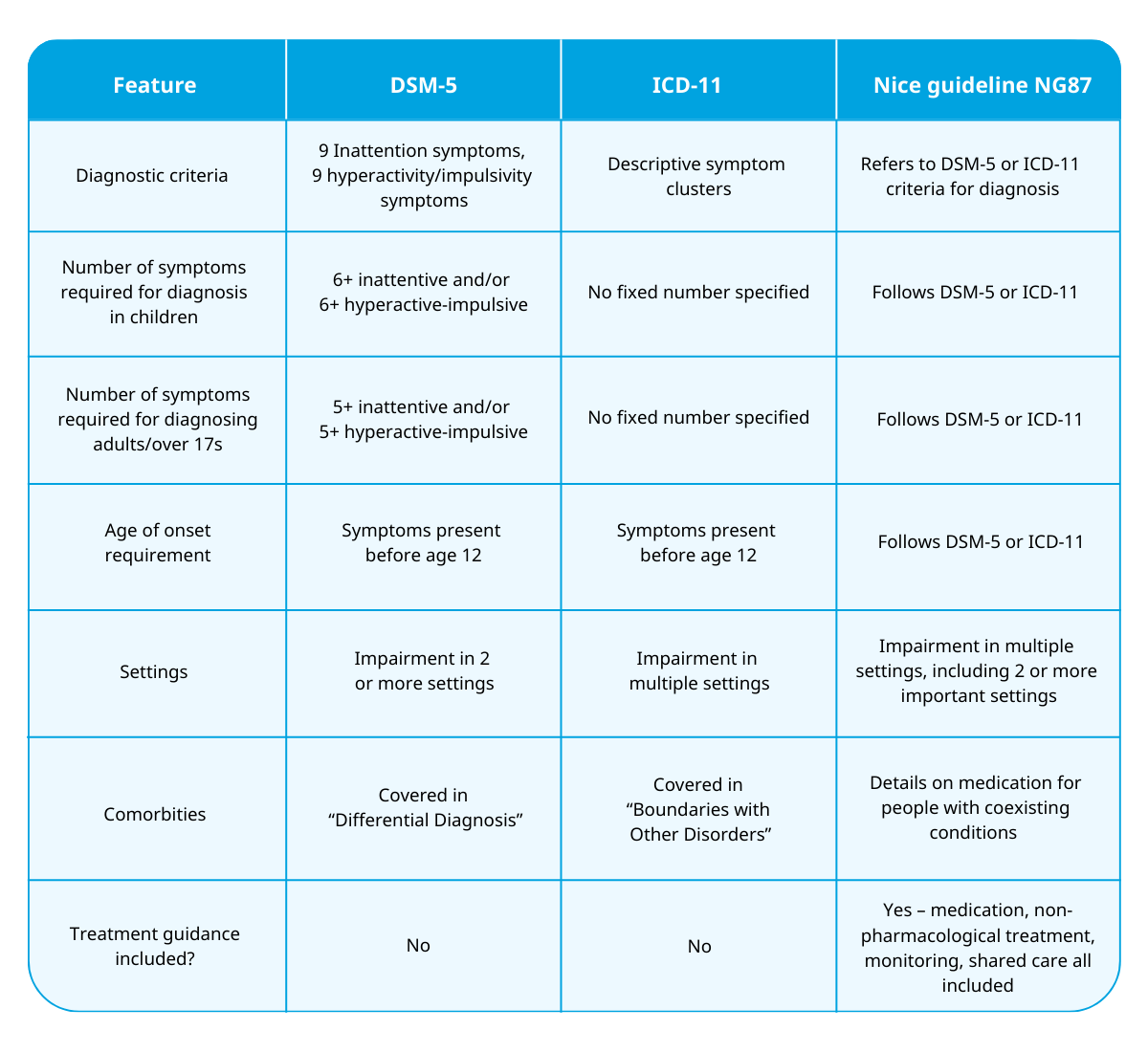
One of the key distinctions between DSM-5 and ICD-11 is the threshold for making a diagnosis. In DSM-5 this is specifically defined with exact numbers of symptoms for adults and children. ICD-11 adopts a more descriptive model, that places more evidence on clinical judgment.
Another distinction is that DSM-5 and ICD-11 are limited to diagnostic criteria, while NICE NG87 provides recommendations on treatment and care.
Is your clinic compliant? Access our benchmarking scorecard for ADHD clinics and measure yourself against the standard.
What is the DSM-5 criteria for ADHD diagnosis?
DSM-5 includes diagnostic criteria to help you diagnose different mental health disorders, including ADHD.
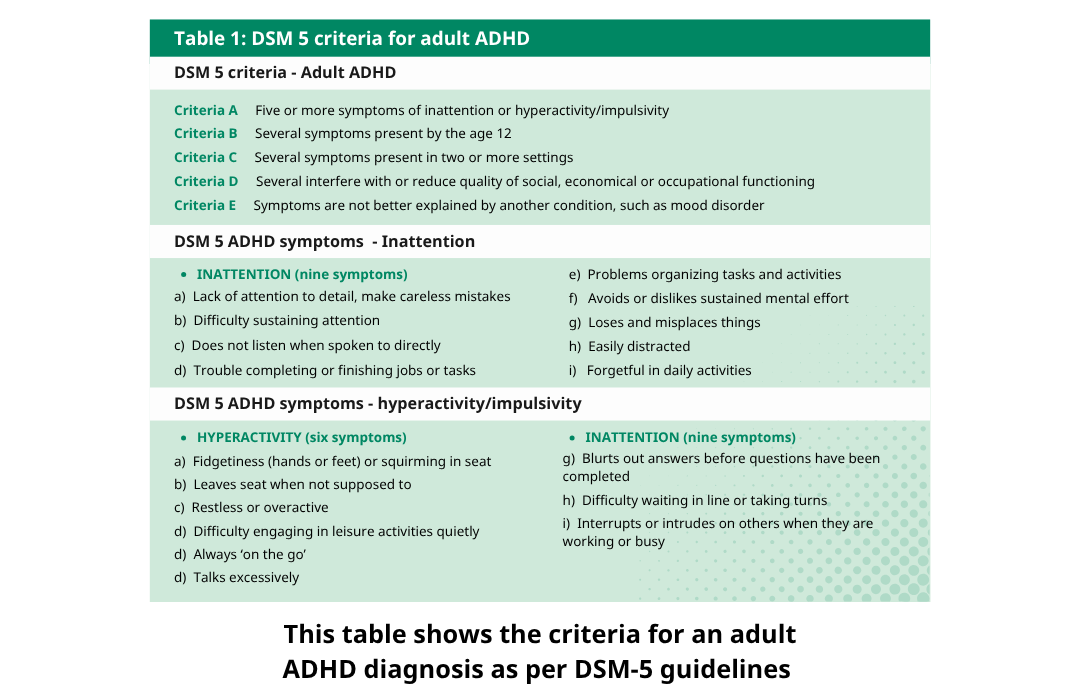
To make a diagnosis of ADHD, the Diagnostic and Statistical Manual, Fifth Edition (DSM-5) says that:
- For children up to age 16, 6 or more symptoms of inattention and/or hyperactivity-impulsivity must be present.
- For adolescents aged 17 or older, and adults, 5 or more symptoms of inattention and/or hyperactivity-impulsivity must be present.
Additionally, symptoms should have been present before age 12 and be evident in at least 2 settings (e.g., home, school, work, socially). There should also be evidence that the symptoms have a significant impact on your patient’s daily life and are not better explained by another mental disorder.
How do you use the DSM-5 ADHD criteria to make a diagnosis?
There are specific examples of how symptoms may present in your patient for each ADHD subtype – inattentive, and hyperactive/impulsive. These symptom descriptors are designed to be broad so that they are recognizable in patients of any age. However, some specifically tailor examples to children and adults. As an example, this inattentive symptom references both school and work settings:
“Often does not follow through on instructions and fails to finish schoolwork, chores, or duties in the workplace (e.g., loses focus, side-tracked).”
When DSM-5 works well, and when it needs support
There are several strengths to using the DSM-5 criteria for ADHD diagnosis:
- It’s a consistent framework, so you’re diagnosing patients based on the same criteria as colleagues the world over. This helps us make direct comparisons on ADHD prevalence in different locations
- DSM-5 works well for structured initial diagnosis, providing a clear framework to follow
- The examples used are deliberately relatable, drawing on everyday experiences. This makes them easy for your patients to understand and recognize
However, because DSM-5 is a broad framework, there are some cases where it is less effective –
- The DSM-5 criteria have been criticized as overly child-focused, male-biased, and too simplified for capturing cultural differences or for diagnosing patients with comorbidities.
- The criteria are descriptive and subjective. This makes it difficult to reassess and quantifiably monitor symptom change over time.
To help mitigate some of these risks, you can use the DSM-5 criteria alongside other ADHD diagnosis tools like a digital ADHD test, rating scales, or clinical interview.
Understand what's changed in the DSM-5 and why it matters clinically.
How rating scales support ADHD assessments
While diagnosing, you rarely rely on symptom criteria alone. Since there's no singular tool that can diagnose ADHD alone, you need a combination of objective and subjective data for a more complete picture of your patient's symptoms and behaviors.
Capturing patient, parent, or teacher feedback using rating scales can provide structured evidence to support assessment of ADHD under DSM-5 or ICD-11 criteria. The ADHD-RS IV rating scale can be use for children and adolescents between the ages of 5 and 17 years. The Vanderbilt Assessment Scale is another validated option for ages 6-12, and includes parent-teacher informant questionnaires. The now fully digitized Conners Rating Scale is ideal for ages 8-18, and for older patients, above the age of 18 years, the ASRS (Adult ADHD Self-Report Scale) is routinely used for symptom screening.
Through a multi-modal approach, further strengthened by the addition of an objective test, you can confidently use DSM-5 or ICD-11 frameworks for diagnosis and treatment. Using an ADHD rating scale comparison guide helps you analyze child and adult rating scales with information on suitability, domains measured, and patient age.
What is the ICD-11 criteria for ADHD?
The ICD-11 code for ADHD is 6A05. Like the DSM-5, the ICD-11 description of ADHD highlights that the condition is characterized by inattention and/or hyperactivity-impulsivity symptoms that were present prior to age 12. These symptoms must directly and negatively impact academic, occupational, or social functioning.
How do you use the ICD-11 ADHD criteria to make a diagnosis?
The ICD-11 guidelines contain examples of symptom clusters for inattention and hyperactivity/impulsivity that span childhood and adult scenarios. There are also some brief notes on sex-and/or gender related features, and culture-related issues that may affect how symptoms appear. Overlapping symptoms and potential comorbidities are detailed in a “Boundaries with Other Disorders and Conditions” section.
What is the NICE guidance for ADHD assessment?
The NG87 guidelines are specific to ADHD and make recommendations for the whole ADHD pathway, covering assessment, referral, evaluation, and long-term condition management.
In October 2024, NICE published Diagnostics Guidance 60 (DG60), providing additional information and recommendations to support NHS delivery of ADHD services. The guidelines were developed with input from stakeholders, including ADHD experts and patient organizations. They include the recommendation to use an objective ADHD test as an option to help diagnose ADHD in people aged 6 to 17 years.
More recently, DG60 has migrated to become HealthTech guidance 729 (HTG729).
What makes an ADHD test NICE compliant?
NG87 does not redefine ADHD diagnostic criteria. Instead, it recommends using DSM-5 or ICD-11 criteria as part of a full ADHD assessment. The option of using an objective ADHD test is highlighted, as recommended in NICE HealthTech guidance HTG729.
Clinical best practices
Choosing the right ADHD diagnosis framework
DSM-5 is more prescriptive in the number of symptoms that must be present for diagnosis, while ICD-11 leaves more flexibility for clinical judgment.
There are also some insurance and coding implications. Even if using DSM-5 for diagnosis, reimbursements are still based on ICD codes, and any mismatches could lead to issues.
Differences in documentation standards between DSM-5, ICD-11, and NICE NG87
Being criterion-led, DSM-5 effectively operates as a checklist of symptoms that you can clearly assign to your patient.
With ICD-11, you can reference the descriptions of symptoms, but documenting your patient’s condition will be more judgment-driven.
By contrast, NG87 is more concerned with how you assess for ADHD and subsequently care for the patient. Aligning with NG87 allows you to show that you have followed the recommended pathway and processes.
Explore practical steps on how to build a future-ready ADHD clinic in 2026
Multi-setting verification challenges across ADHD guidelines
All 3 frameworks require evidence of impairment across multiple settings; however, there are subtle differences.
DSM-5 is specific about symptoms appearing in 2 or more settings. This can make verification challenging, especially for adults, where historic school records may not be available to support diagnosis.
As ICD-11 references multiple contexts, you may have more flexibility in assessing multi-setting impairment.
NG87 also refers to multiple settings, but with some additional expectations that the settings are important and that impairment happens often, making NICE guidelines perhaps the most prescriptive in terms of verification.
Multi-modal assessments help reduce diagnostic drift. See how you can implement this in your clinic
Using objective tools to support assessments across frameworks
Diagnosing ADHD using either DSM-5 or ICD-11 is inherently subjective. You’re relying on feedback from patients, parents, and teachers to assess symptom severity and impact. It’s not uncommon for symptom reporting to vary significantly between responders. ADHD patients in particular struggle with self-evaluation and may overestimate symptoms.
Adding an objective test to your assessment process, as recommended in NICE NG87, can help. Diagnosing ADHD based on a multi-modal evaluation allows you to cross-check findings from different sources and identify inconsistencies early on.
Combining objective data with DSM-5 or ICD-11 can also help you to assess ADHD compared with comorbidities such as ASD.
Frequently asked questions about ADHD frameworks (FAQs)
1. What is the difference between DSM-5 and ICD-11 for ADHD?
Both DSM-5 and ICD-11 define diagnostic criteria for ADHD. However, there are subtle differences. DSM-5 has a strict symptom count for diagnosis, while ICD-11 is more evaluative. DSM-5 requires impairments to be evident in 2 or more settings, while ICD-11 refers to evidence of impairment in multiple settings.
2. Does NICE recommend DSM-5 or ICD-11?
In the ADHD guidance NG87, NICE recommends the use of either DSM-5 or ICD-11 for ADHD diagnosis. NICE also specifies that impairment happens often and in multiple settings.
3. Which ADHD criteria should clinicians use in the US vs Europe?
The framework you choose will depend on personal preference and also where you are based. DSM-5 and ICD-11 are both used globally, but DSM-5 is the most commonly used in the United States. However, ICD-11 is still required for billing and reimbursement coding in the United States. NICE NG87 is specific to England (though used in other parts of the UK too) and covers the whole care pathway.
Parts of the ADHD care journey, such as diagnosis, titration, and routine check-ins, are well-positioned for delivery in a hybrid model.
4. Are ADHD subtypes defined differently in DSM-5 vs ICD-11?
Both DSM-5 and ICD-11 recognize inattentive, hyperactive-impulsive, and combined subtypes of ADHD. However, there are subtle differences in diagnosis requirements. DSM-5 uses fixed symptom thresholds, whereas ICD-11 relies on descriptive clinical judgment to determine which subtype is diagnosable.
5. Can standardized objective testing improve consistency across frameworks?
Adding an objective test can help you cross-check and verify subjective findings. This can support you in diagnosing ADHD based on a wider and more objective dataset.
6. Is DSM-5 TR the same as DSM-5?
The DSM-5 TR is an updated version of DSM-5 published in 2022. The update expanded symptoms to include more adult signs of ADHD and made some demographic notes about how sex, gender, social class, race, and ethnicity may affect symptom reporting.
You can benefit from validated objective technology
While DSM-5 and ICD-11 provide the diagnostic foundation, and NICE offers guidance on the broader care pathway, no single framework fully captures the complexity of real-world presentations. In practice, clinicians draw on these guidelines alongside multi-informant input and, where appropriate, objective data to build a comprehensive and defensible assessment.