

By Shaun Hopkins, Head of Professional Business EU, Qbtech Ltd
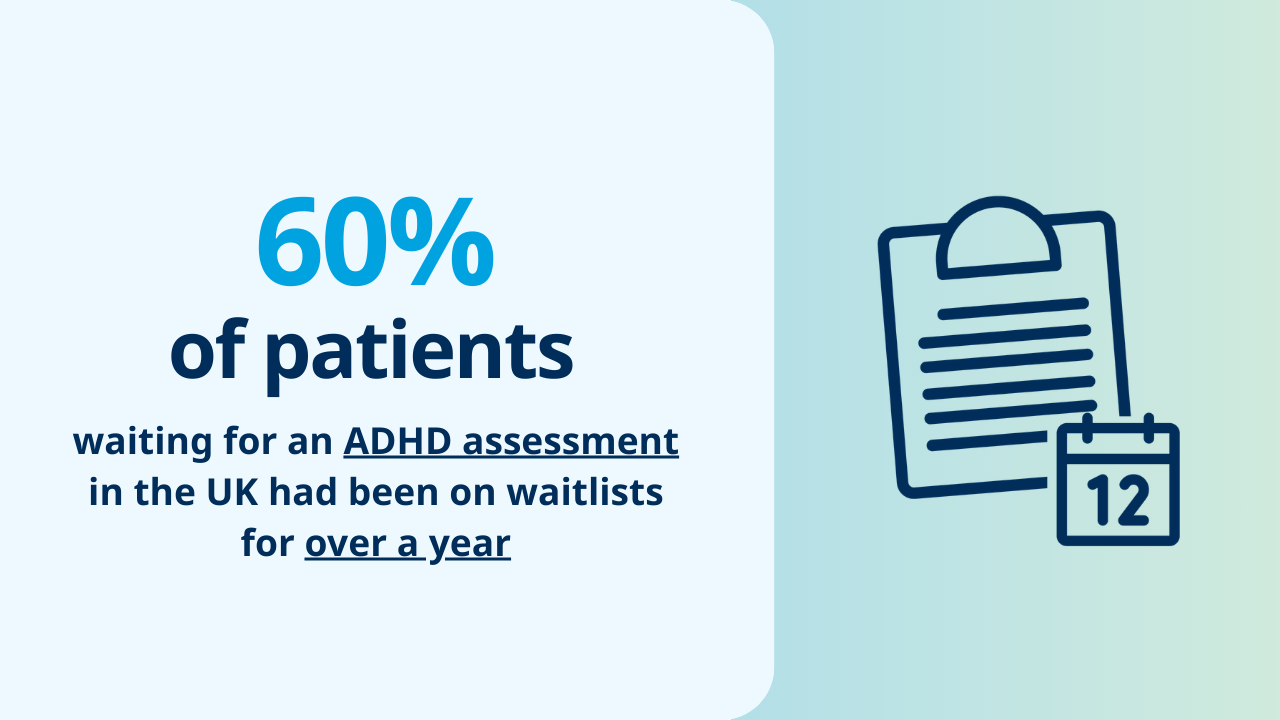
ADHD services are under growing pressure in England. NHS estimates for February 2026 suggest over 735,000 people may be waiting for an ADHD assessment1. On average, adults and children in England face an 8-year delay,2 and in the worst-affected areas, wait times are as much as 10–15 years3.
NHS ADHD services help huge numbers of patients every year. However, they’re struggling to deal with the unprecedented demand for assessment and treatment. In response, many of the UK’s Integrated Care Boards (ICBs) have introduced caps on the number of patients that can be assessed for ADHD in 2025-20262.
The shift from delays to limits is significant. We’re no longer witnessing a system that is simply overloaded, but one where structural changes are being made just to continue functioning.
Many services are responding proactively, reviewing pathways, and identifying opportunities for ADHD technologies to reduce diagnostic times. This mapping of patient journeys to identify the optimum place in the pathway for objective testing is a key step. However, to see nationwide change and backlogs cleared, this response needs to be universal.
The human cost of England’s overloaded ADHD system
While long wait lists persist, more people are living with undiagnosed ADHD for longer. The NHS estimates the cost of untreated ADHD in the UK to be around £17 billion per year3. However, the real cost is to patients. People with ADHD are at increased risk of suicidal behaviors, substance misuse, accidental injury, traffic accidents, and criminality4. Educational and employment outcomes are poorer, and physical and mental health are worse.5 Life expectancy for people in the UK with ADHD could be reduced by as much as 6.78 years for males and 8.64 years for females.
Treatment can make a significant difference. In a cohort of 148,581 individuals starting ADHD medication, there was a 17% reduction in suicidal behavior, 15% in substance misuse, 12% in transport accidents, and criminality also reduced by 13%4. Behind every delayed diagnosis is a list of people whose lives feel out of control and who blame themselves for years while waiting for an ADHD assessment.
The structural challenges facing the UK’s ADHD services
Problems aren’t limited to long wait times. The NHS is going through major restructuring changes that ICB leaders claim are bigger barriers to service improvement than either funding or demand.
Urgent and systematic changes are needed to transform the UK’s ADHD care, helping reduce delays, clear backlogs, and meet patient expectations. However, any solutions must be viable against this backdrop of NHS reorganization, changing responsibilities, and fluctuating staffing.
So, what can you do?
Addressing England’s ADHD diagnosis crisis:
Actions for clinicians, policymakers, advocates, and educators
Change on the scale required is rarely easy. But we believe improving outcomes for ADHD patients in the UK is achievable. Following the evidence-based ADHD Taskforce recommendations will help. So too could a more proactive approach from all of us who work in ADHD.
What can policymakers do?
Systemic change often requires a high-level hook that can be used as a platform for improvement. We’ve already seen how this can happen in the ADHD space. The NICE recommendation to incorporate an objective ADHD test as an assessment option is a strong example. By discussing the merits of objective data for ADHD diagnosis in HealthTech guidance 729, funding commissioners, clinicians, and advocates have strategic support for adding the technology to workflows.
Policymakers can make an impact, even in the short term, by focusing on practical solutions that make the best use of existing, readily available resources. Digital technology is a strong case in point and should be part of policy discussions. Objective technology helps clinicians to gather important symptom information early in the model, supporting a needs-based approach and more efficient use of service capacity.
Additionally, you can commission objective assessment technologies, fund digital-first pilot workflows, and embed guidance in policy documents to support the use of ADHD tools across local services.
What can you do as a clinician or GP to help UK ADHD patients?
While national policy-led change can be slow, you can make local improvements more rapidly. Digital ADHD tests can help you gather objective data quickly, reducing the time required for each assessment. Offering remote appointments can help you see more patients7 and further help reduce backlogs.
Implementing hybrid models of ADHD care and digital-first ADHD models can help make care more accessible and flexible for patients, while also reducing clinics’ admin burden8. You can then communicate examples of effective workflows to policymakers as models for replication and wider rollout.
Triaging how patients are seen can also help maximize efficiency for you and your team. At North Staffordshire Child and Adolescent Mental Health Services (CAMHS), nurse practitioners now use a digital ADHD test to support them in completing ADHD assessments. Previously, all patients would have been referred to specialist services. Under the new model, wait times have reduced from around 18 months to 12 weeks. The workflow is more consistent, as all patients are assessed using the same methodology. Referrals are saved for the most complex cases, maximizing staff time efficiency across the model.
Amid growing demand, there is an urgent need to move beyond one-size-fits-all assessment models. Objective technology has a critical role to play in identifying individuals most at risk and supporting more informed triage decisions. This will help clinicians determine when a full diagnostic assessment is necessary and when alternative approaches may be more appropriate. This can also help drive proportionate care, which is truly needs-based and is tailored to the individual and responsive to how their symptoms present across different settings.
Making these efficiency changes to your service or clinic has the potential to improve patient outcomes in your area, without long lead-in times for development or policy shift.
A role for educators
Around 618,000 children and young people (aged 0-17) in England9are estimated to have ADHD. Education settings are understandably critical spaces for early identification of symptoms. Helping children get access to treatment and support from a young age is key, and educators have a vital role. Teachers are often asked to contribute to rating scale assessments during diagnosis. They will also be involved in implementing Individual Education Plans (IEPs) for students with ADHD.
Despite the important role of educators, there are significant knowledge gaps around ADHD. An Open University study found accurate ADHD knowledge to be low among teachers, and ‘negative attitudes’ to ADHD more common than ‘positive attitudes’10.
As clinicians, you can support educators to learn more about ADHD and even develop school-based ADHD screening11pathways. Making classrooms more ADHD-friendly is also an important goal. If you work with educators, you may wish to recommend this printable checklist. It’s designed to help the teachers of ADHD students, so that they can stay focused, engaged, and successful.
There is also a wider role for education in ADHD care. A 2025 survey of ADHD patients found that 64% of them said they received either no information or poor information while waiting for a diagnosis12. It doesn’t have to be this way.
While people are on waiting lists for ADHD, we can provide them with reliable, medically grounded psychoeducation on ADHD symptoms and examples of non-pharmacological lifestyle adaptations that can help. If we don’t, those same patients will either feel unsupported or turn to less reliable information sources like social media for answers.
The importance of ADHD advocacy
Finally, there is a strong role for patient advocacy. ADHD advocates can set up the support systems that can make a real difference to ADHD patients’ lives. Peer support networks and sharing reliable information sources can help plug some of the resource gaps in formal health systems.
Advocates are also well-placed to highlight the impact of undiagnosed and later-life ADHD diagnoses on adults. It’s estimated that fewer than 1 in 5 adults who have ADHD are diagnosed or receiving treatment13. These are adults whose symptoms were often missed during childhood, and who may have developed coping strategies that mask symptoms in adulthood.
Demand for adult ADHD assessment is high. In December 2025, 11,465 people over the age of 18 were newly referred for a potential ADHD assessment1. This figure was up nearly 37% from the same period the previous year.
Adult ADHD assessments are complex. A lack of developmental history, missing school records, and difficulties in recalling or self-assessing symptom presentation can make diagnosis challenging. Additionally, while awareness of adult ADHD has improved, many GPs still report having low confidence, limited knowledge, and often misconceptions about ADHD14.
Advocates can highlight the need for better adult ADHD care, including the use of ADHD tools to support testing and treatment. Using an objective test can increase clinician confidence in diagnostic decision-making without compromising accuracy.7 Digital ADHD tests can also help assess symptom change after commencing medication15. Patient support groups can advocate for the wider implementation of these standardized and consistent approaches to adult ADHD assessment and treatment using objective testing.
From crisis to opportunity:
Rethinking ADHD care delivery
Change is necessary. ADHD services in the UK are struggling to keep pace with demand, and the impact on patients is significant.
However, all of us have the opportunity to help improve the system. New models of care are emerging. Digital ADHD assessments, hybrid care models, and effective triaging can help to address the backlog in assessments and change the baseline of how long the process needs to take. In the meantime, we can also help patients with better education resources and support.
Together, we can work towards an ADHD care model that better serves UK ADHD patients now and into the future.
Citations
1. NHS Digital. ADHD Management Information: February 2026. NHS Digital. 2026 Feb 26.
https://digital.nhs.uk/data-and-information/publications/statistical/mi-adhd/february-2026
2. Marsh S. NHS limiting number of ADHD assessments despite soaring demand. The Guardian. 2026 Jan 15.
https://www.theguardian.com/society/2026/jan/15/nhs-limiting-number-of-adhd-assessments-despite-soaring-demand
3. NHS England. Plain English summary of the ADHD Taskforce report. NHS England. 2025 Dec 9. Available at:
https://www.england.nhs.uk/long-read/plain-english-summary-of-the-adhd-taskforce-report/
4. Zhang L, et al., ADHD drug treatment and risk of suicidal behaviours, substance misuse, accidental injuries, transport accidents, and criminality: emulation of target trials. BMJ. 2025 Aug 13;390:e083658.
https://doi.org/10.1136/bmj-2024-083658
5. O'Nions E, et al., Life expectancy and years of life lost for adults with diagnosed ADHD in the UK: matched cohort study. The British Journal of Psychiatry. 2025 May;226(5):261–268.
https://doi.org/10.1192/bjp.2024.199
6. Launder M, et al., Restructure a bigger problem than funding, say ICB leaders. Health Service Journal. 2025 Nov 4; Integrated care.
https://www.hsj.co.uk/integrated-care/restructure-a-bigger-problem-than-funding-say-icb-leaders/7040325.article
7. Hollis C, et al., The impact of a computerised test of attention and activity (QbTest) on diagnostic decision‑making in children and young people with suspected attention deficit hyperactivity disorder: single‑blind randomised controlled trial. Journal of Child Psychology and Psychiatry. 2018 Dec;59(12):1298–1308.
https://doi.org/10.1111/jcpp.12921
8. Malik N, et al., The role of electronic health records (EHR) in reducing healthcare costs and improving patient outcomes: a systematic review. Journal of Neonatal Surgery. 2025 Jul;14(32S):5142–5154.
https://doi.org/10.63682/jns.v14i32S.8262
9. Stiebahl S, et al., FAQ: ADHD statistics (England). House of Commons Library Research Briefing. 2026 Mar 4; CBP‑10551. https://commonslibrary.parliament.uk/research‑briefings/cbp‑10551/
10. Adamis D, et al., Primary and Secondary Education teachers’ knowledge and attitudes towards Attention Deficit Hyperactivity Disorder (ADHD). International Journal of Disability, Development and Education. 2025;72(8):1439–1455.
https://doi.org/10.1080/1034912x.2024.2370800
11. Barry TD, et al., School‑based screening to identify children at risk for attention‑deficit/hyperactivity disorder: barriers and implications.Child Health Care.2015 Sep;45(3):241–265.
https://doi.org/10.1080/02739615.2014.948160
12. Healthwatch Redbridge, People with ADHD find diagnosis life‑changing but long waits on the NHS need urgent action. Healthwatch Redbridge News. 2025 Jun 2.
https://www.healthwatchredbridge.co.uk/news/2025‑06‑02/people‑adhd‑find‑diagnosis‑life‑changing‑long‑waits‑nhs‑need‑urgent‑action
13. Prakash J, et al., Adult attention‑deficit hyperactivity disorder: From clinical reality toward conceptual clarity. Industrial Psychiatry Journal. 2021 Jan‑Jun;30(1):23 28. https://doi.org/10.4103/ipj.ipj_7_21
14. French B, et al., Evaluation of a web‑based ADHD awareness training in primary care: pilot randomized controlled trial with nested qualitative interviews. JMIR Medical Education. 2020 Dec 11;6(2):e19871.
https://doi.org/10.2196/19871
15. Sanyal RY, et al., Utilizing remote objective ADHD testing to monitor symptom improvement following medication treatment. International Journal of Psychiatry Research. 2024;7(3):1–6.
https://doi.org/10.33425/2641‑4317.1195