
Measurement-based care isn’t something new. However, the principles have the potential to be a cornerstone of evidence-based practice. Adopting a measurement-based care approach can provide you with valuable data to support clinical decision-making.
In this blog, we speak with Dr. Phil Anderton, Founder and Former CEO of ADHD 360, to find out more about measurement-based care. Through this Q&A, you can learn how to better help your patients and improve outcomes.
What is measurement-based care?
In an ADHD clinic setting, measurement-based care can be defined as a rich data set that stretches beyond the collection, analysis, and measurement of the systematic evolution of patient symptoms and impairment levels before or during the clinical encounter. For example, data on physical health and anticipated treatment outcomes.
If you use rating scales or standardized diagnosis frameworks like DSM-5, ICD-10 or ICD-11 to assess ADHD, then you are already collecting the right data to help you reach a diagnosis. Measurement-based care takes this a step further by embedding the use of this data consistently across the ADHD workflow to inform treatment decisions.
Why are integrated care models important in ADHD management?
If we’re not measuring our impact, or we’re not measuring the right things. We can’t know that we’re doing all that we can to help our patients. In my opinion, it’s not enough to just use the DSM-5 criterion. They can often feel ambiguous or arbitrary1 and may miss cultural and demographic differences2. Instead, we need to be sure that we are consistently measuring and comparing symptom and health presentations at pre-diagnosis and during treatment on the same standardized scales.
Real-life examples of measurement-based integrated care
We see measurement-based care in action in physical healthcare all the time. We check vital statistics like blood pressure, pulse, and weight quantitatively and consistently, and use them to inform a patient’s treatment.
At ADHD 360, we introduced a standardized objective ADHD assessment tool into our remote clinical workflow. A baseline test was carried out pre- diagnosis, and then a follow-up after starting medication. The report provides our clinicians with symptom measures of inattention, impulsivity, and hyperactivity. The Total Symptom Score helps in indicating the likelihood of that patient having ADHD.
We also collect patient rating scale data and data on other matters, including the use of alcohol and nicotine. This multi-modal, measurement-based approach means that our clinicians make decisions based on evidence. These help cross-validate findings, interpret symptom change over time, and rule out or diagnose ADHD in cases of comorbid or co-occurring symptoms.
Measurement-based care and ADHD treatment and titration
We can use objective data to help us treat ADHD patients and titrate their medication dose. The data from a digital ADHD test can supplement any subjective feedback and provide you with quantifiable measures of medication effect3 on symptoms. You can fine-tune a patient’s dose and see how medication adjustments change their symptoms. This allows you to base decisions on objective data rather than subjective recall.
How can we bridge the gap between measurement-based care and quality of life?
When we look at patient data, we can see that there is a strong correlation between reductions in Total Symptom Scores on ADHD test results and improvements in patients’ quality of life, as reported in QoL-based rating scales. As symptom scores reduced, so too did tobacco and alcohol usage, all adding up to life quality enhancements.
I think this is such a critical argument for measurement-based care. In itself, symptom reduction can feel hard to quantify. We know that ADHD patients can find accurate self-assessment of symptoms difficult4. What really matters and what resonates with patients is improvements to their quality of life.
Being able to make and maintain friendships, coping at work or school, feeling less frustrated, and sticking to routines and appointments are all examples of patient-oriented quality of life improvements. Measurement-based care is emerging as a credible solution to this disconnect. We can use a Quality of Life Index and couple this with other measures. Changing tobacco or alcohol usage, for example, shows meaningful improvements to that person’s life from ADHD treatment.
Linking measurement-based care to meaningful everyday outcomes
The case for measurement-based ADHD care: I think we need to stop seeing consistent data collection in ADHD as optional or supplementary. If we were dealing with physical health, we wouldn’t omit vital measurements like blood pressure from analysis. We need to see mental health in the same way. We must place measurement-based care at the heart of the ADHD journey.
Supporting patients: If we measure the right things, we can also support patients to set meaningful patient-centered goals. Patients can tell us what matters to them, whether that’s completing homework on time or going to a social event weekly without feeling overwhelmed. We can then incorporate that outcome into our assessment of treatment impact. It then becomes something meaningful and personal.
This more personalized approach to treatment can help patients feel more engaged and valued.
Common barriers and practical solutions
Implementing measurement-based ADHD care
❌ Barrier: There is some initial investment required in collecting more data, and it requires some process adjustments.
✅ Solution: Critically review your pathway and redesign your workflow to embed measurement-based care in a digital-first workflow.
❌ Barrier: Some patients may also have concerns about data security and privacy with additional data collection.
✅ Solution: Electronic health records (EHRs) are widely used and increasingly familiar to patients. They also have several benefits, including improving care quality and reducing drug dosage errors5.
How ADHD 360 implemented a measurement-based care approach
Frequently Asked Questions (FAQs)
Q. Does measurement-based care risk replacing clinical judgement with “scores”?
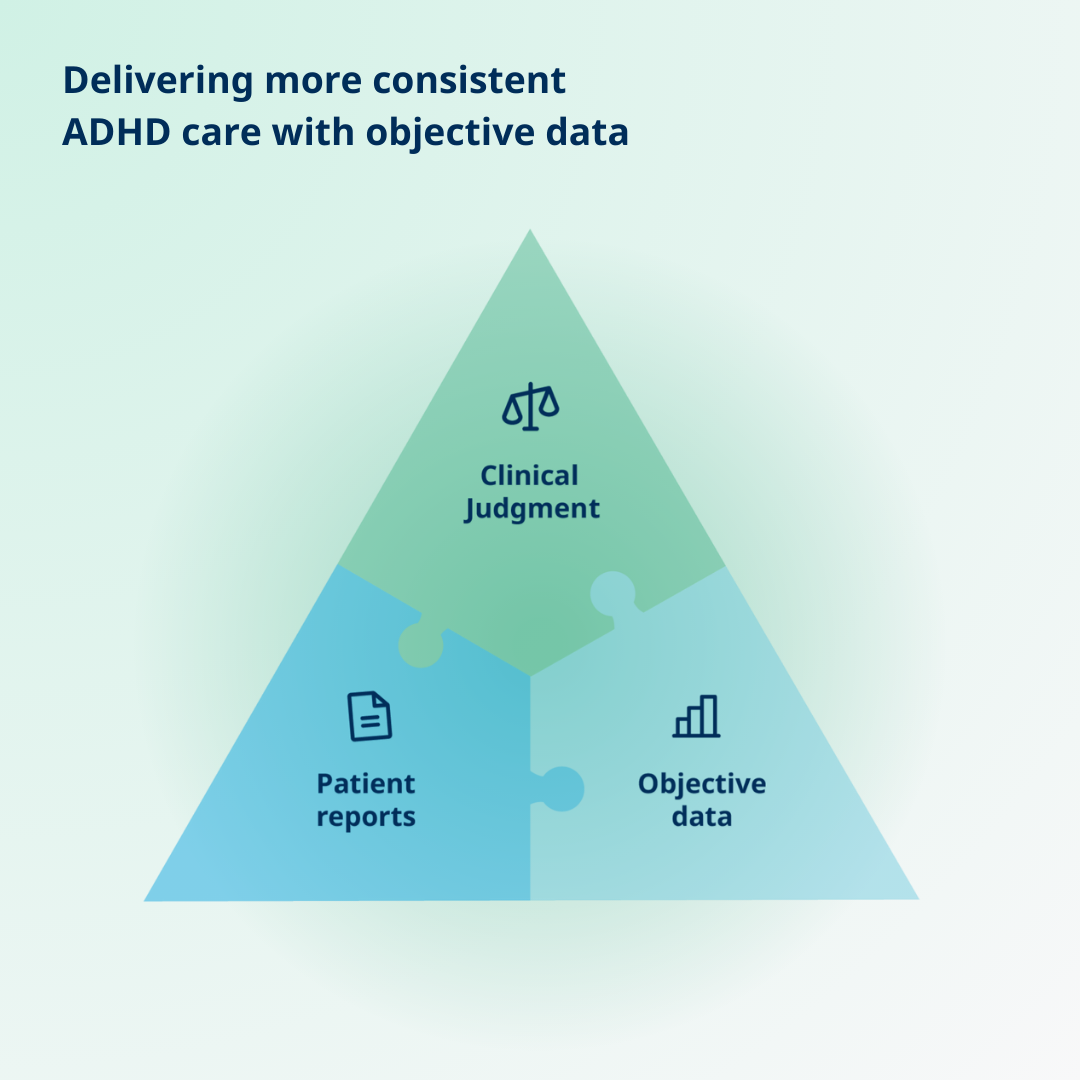
Measurement-based care is designed to support clinical judgement, not replace it. The aim is to provide additional data that can help you diagnose with increased confidence and monitor treatment. All clinical decisions are still made by you. It’s about providing you with a standardized, quantitative baseline of ADHD symptoms that you can refer to throughout treatment and diagnosis.
Q. Will measurement-based care add extra time and administrative burden to ADHD workflows?
In many cases, adopting a more data-led approach to ADHD care can actually be more time efficient. Most additional data sets can be collected electronically. This digital-first approach may help reduce your admin burden and facilitate data sharing with colleagues to collaboratively review complex cases. Having access to data from objective tests can also reduce the time from assessment to final decision.
Q. What data should I collect for ADHD assessment and symptom tracking?
For an effective multi-modal approach to measurement-based care, subjective data from rating scales and the clinical interview can be combined with the results of an objective test. Additional measures can also be included where useful. At ADHD 360, we found alcohol and tobacco usage to be helpful indicators of lifestyle change following treatment. The key is to collect meaningful data consistently so that you can compare how results change with medication.
Q. How often should ADHD symptom data be measured?
Data collection should be aligned with the patient journey. At initial assessment, the data you collect forms the baseline to compare with at treatment. During titration, you will likely collect some data more frequently, even weekly, to inform the micro adjustments to medication. As the patient enters long-term care phases, data collection will become more periodic and aligned to the frequency of treatment reviews.
Sources cited
- Honkasilta J, Koutsoklenis A. The (un)real existence of ADHD—criteria, functions, and forms of the diagnostic entity. Frontiers in Sociology. 2022 May;7:814763. https://doi.org/10.3389/fsoc.2022.814763
- Chan WWY et al., Attention-deficit/hyperactivity disorder (ADHD) in cultural context: Do parents in Hong Kong and the United Kingdom adopt different thresholds when rating symptoms, and if so why? International journal of methods in psychiatric research. 2022 June 7;31(3):e1923. doi: 10.1002/mpr.1923.
- Sanyal R, et al., Utilizing remote objective ADHD testing to monitor symptom improvement following medication treatment. International Journal of Psychiatry Research. 2024; 30;7. https://doi.org/10.33425/2641-4317.1195
- Mörstedt B, et al., Attention-Deficit/Hyperactivity Disorder (ADHD) in Adulthood: Concordance and Differences between Self- and Informant Perspectives on Symptoms and Functional Impairment. Public Library of Science. 2015 Nov 3;10(11):e0141342. doi: 10.1371/journal.pone.0141342.
- Atasoy H, et al., The Digitization of Patient Care: A Review of the Effects of Electronic Health Records on Health Care Quality and Utilization. Annual Review Public Health. 2019; 40:487-500. https://doi.org/10.1146/annurev-publhealth-040218-044206
- Malik N, et al., The role of electronic health records (EHR) in reducing healthcare costs and improving patient outcomes: a systematic review. Journal of Neonatal Surgery. 2025 Jul 14;14:5142–5154. https://doi.org/10.63682/jns.v14i32S.8262
- Hollis C, et al., The impact of a computerised test of attention and activity (QbTest) on diagnostic decision making in children and young people with suspected attention deficit hyperactivity disorder: single-blind randomised controlled trial. Journal of Child Psychology and Psychiatry. 2018 Dec;59(12):1298-1308. https://doi.org/10.1111/jcpp.12921