

High demand for testing, long waitlists, complex presentations, high patient expectations, and concerns over care accessibility are widespread. So, how can clinicians overcome these challenges?
Implementing a digital-first care workflow can help clinicians see more patients and reduce appointment backlogs. Such tools can also promote patient understanding through psychoeducation, support adherence to treatment plans, and enable symptom-monitoring and self-regulation. Our guide will help you build your ADHD clinical workflow according to today’s rising standards.
What does a digital ADHD clinic look like?
A digital-first ADHD clinic uses technology to streamline processes normally handled in-clinic. You can conduct assessments, consultations, and follow-ups, and complete paperwork using secure video calls, online forms, and digital information portals. Thereby, you reserve in-clinic visits for more complex cases or critical interactions.
The goal of a technology-enabled clinic is to make ADHD care more accessible, flexible, and efficient for both patients and clinicians. This helps in cutting costs and wait times and improves overall clinical outcomes. The illustration below demonstrates how to integrate digital processes in your service.
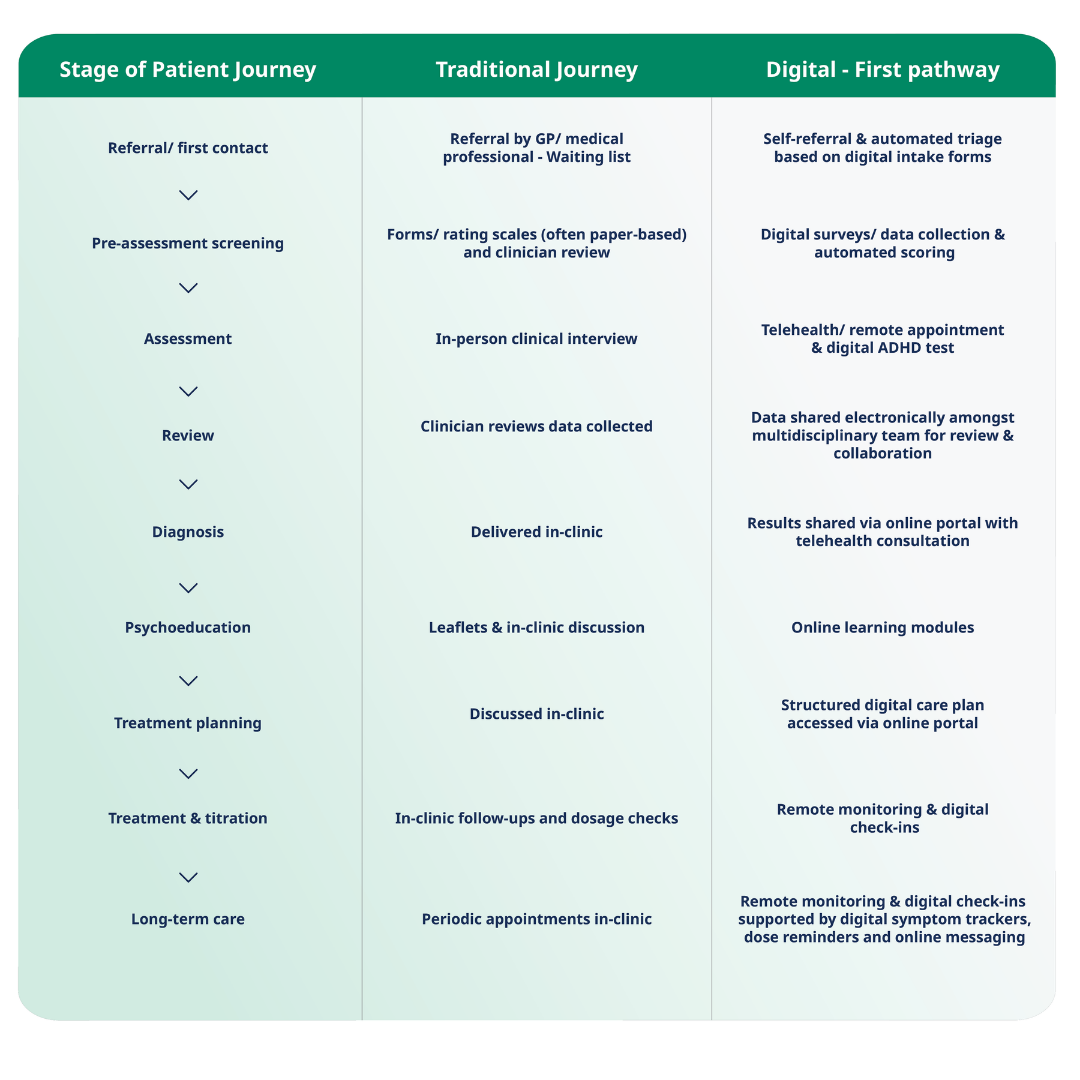
Disclaimer: The digital interventions listed are examples and do not constitute a recommended clinical workflow or medical advice. Clinician discretion is advised.
How to design a modern ADHD clinic
When redesigning ADHD workflows, it’s important that the new model:
✅ Retains patient-clinician engagement and oversight
✅ Collects all necessary data
✅ Remains flexible
✅ Meets patient needs and expectations
Clinicians should keep the above key considerations in mind when developing a digital-first approach. Here are some ways to achieve this –
→ Identify data requirements and streamline data capture and processing
Only information that serves a direct operational or patient need should be collected, minimizing inefficiencies. Standardizing data collection, for example, by using the same digital ADHD test as part of every patient’s evaluation, promotes consistent and quality care.
→ Balance flexibility and standardization
Automation and formalized systems can deliver efficiencies and increase patient confidence in their care. However, you should retain flexibility. Stress testing workflow design with different patient personas can identify any gaps or barriers to flexible care. As an example, telehealth appointments can help with optimizing clinician time. However, there should always be the opportunity for in-clinic care for complex cases.
→ Integrate treatment, care management, and communication into the workflow
In traditional ADHD models of care, there is a high risk of patient discontinuation between appointments. Digital portals act as hubs for sharing care plans, symptom monitoring, psychoeducation, and secure messaging between appointments. These can increase engagement and secure patient buy-in, supporting care continuity. continuity.
→ Track metrics and outcomes to drive improvement
A strength of the digital clinic is increased availability of quality data on patient outcomes and operational effectiveness. Adding metrics from digital tools into clinic performance monitoring can guide patient care decisions and inform business planning, e.g., identifying efficiencies and scaling opportunities. An efficient way to do this is using tools that offer a clinician portal to manage patient profiles, multiple sites, and testing administration.
→ Set expectations early through clear digital communication
Clear, accurate information on your website, such as explainers, FAQs, and workflow overviews, helps patients understand what to expect from your clinic’s ADHD model. Moreover, it helps reduce uncertainty before the first appointment, leading to improved patient outcomes. Efficient marketing and communication can help you scale your practice, attain right-fit referrals, and better informed patients entering your workflow.
Why hybrid ADHD models benefit clinicians and patients
A hybrid ADHD care model has many benefits. Let’s take a look at why clinics should opt for a hybrid model of delivery:
- Admin burden is reduced as staff collect data digitally
- Clinicians have improved access to patient data and history, which they can easily share within the team
- Appointment scheduling is optimized, maximizing clinic efficiency and minimizing disruption to patients
- Accessibility is increased for marginalized populations
- Digital-first clinical workflows are highly scalable, supporting clinic expansion and screening of large populations
Hybrid models hold potential to blend technological innovations with personalized patient care.
Measuring success when digitizing ADHD workflows
Integrating digital tools into ADHD care models can offer significant benefits. Researchers developed an online portal that combined ADHD psychoeducation, FAQs, and a medication decision-making component. Patients using the system showed increased satisfaction and were more likely to start medication. The time to treatment initiation (TTI) also reduced by 41%, from a mean of 86 days to 51.
A digital-first approach enabled the clinic to clear a post-diagnostic bottleneck by reducing clinical and administrative time in medication decision-making.
However, while such successful outcomes are possible, digital-first workflows should always be seen as a foundation, rather than an endpoint. The goal isn't to design the most digitally enabled workflow, but rather to develop one that uses technology to empower clinicians and patients.
Remember, an effective digital model supports clinicians, increases diagnosis accuracy, and promotes patient acceptance of diagnoses.