

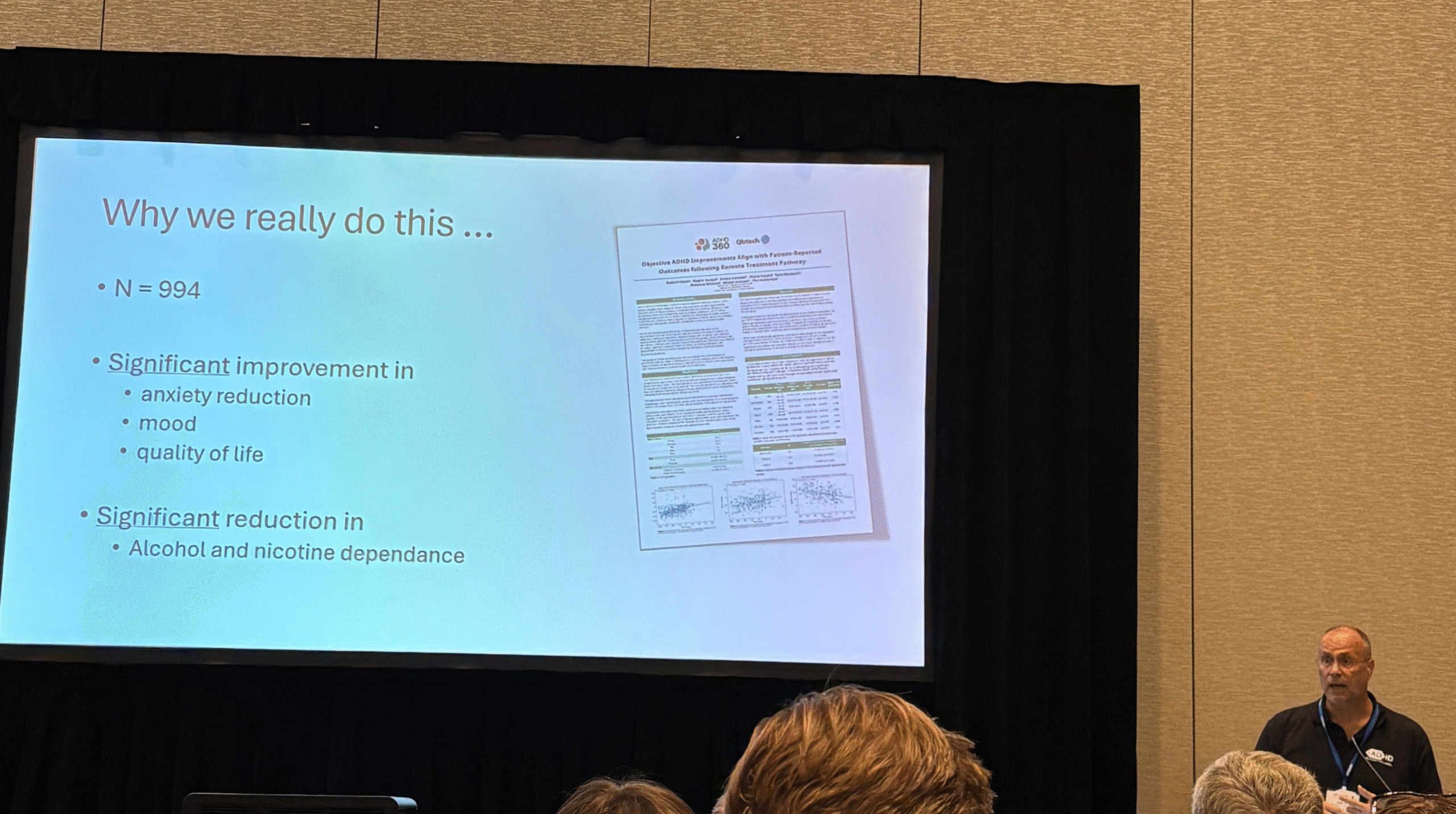
Last week, Robert Nolen, Clinical Research Manager at Qbtech, presented findings from a breakthrough study at APSARD alongside Phil Anderton, former CEO and Founder of ADHD 360. The study demonstrates a strong correlation between reductions in Total Symptom Scores (TSS) on QbCheck test results and improvements in patients’ quality of life. There was also a reported reduction in TSS correlating with improvement of reported depressive symptoms.
Assessed using the Adult ADHD Quality of Life (AAQoL) scale, this link between objective symptom change and lived patient experience has significant implications for how ADHD care is delivered and evaluated, particularly in virtual settings.




Bridging the gap between ADHD symptom improvement and real-world impact
Despite growing demand for ADHD services, there remains limited consistency in how treatment effect is measured. In both clinical trials and routine practice, symptom reduction, often captured through rating scales, has traditionally been the primary indicator of effectiveness. However, rating scales are highly subjective and vulnerable to responder bias.
Quality of life measures can be included, typically through a clinician interview or tailored rating scales such as AAQoL or the Conners’ Quality of Life subscale, for additional context. However, these measures remain subjective, and patients have reportedly struggled with self-assessment of symptom improvements.
Payors and national health services, including the NHS, are increasingly asking for clearer evidence that ADHD interventions improve not only symptom scores, but patients’ day-to-day functioning and wellbeing.
This research effectively helps bridge the gap by evaluating symptom changes alongside quality-of-life metrics, using objective measurement and patient-reported outcomes.
Study overview
Assessing ADHD outcomes in real-world practice
Data for the study was collected from routine assessments of patients within ADHD 360’s digital healthcare model in the UK. Results reflected real-world clinical practice rather than a controlled trial environment. Patients completed a structured evaluation that included:
- A digital objective ADHD test (QbCheck)
- Standard clinical rating scales
- The Adult ADHD Quality of Life (AAQoL) questionnaire
- GAD-7 (anxiety scale) and PHQ-9 (depressive symptoms measure) to assess self-reported symptoms
Results from digital ADHD tests are already used to monitor treatment effect and titrate medication dosage. This study builds on that existing work to evaluate the change in scores between baseline and post-treatment optimization visits. Its purpose was specifically to investigate the correlation between changing Total Symptom Scores on the objective test and results of the AAQoL questionnaire, alongside other indicators of overall patient well-being.
Study findings
Objective ADHD symptom change correlates with patients’ quality of life improvement
The analysis focused on changes in Total Symptom Score (TSS) between baseline measures and follow-up appointments on the digital test, alongside corresponding changes in patient-reported AAQoL scores.
Findings showed that where a patient’s TSS decreased following treatment intervention, quality of life scores improved. This demonstrates that a lower TSS can serve as a strong indicator of improved quality of life post-treatment.
Additional observations reinforced the pattern. Patients with reduced TSS also reported decreases in tobacco and alcohol usage. There was also a reported reduction in TSS correlating with improvement of reported depressive symptoms. This suggests that with better ADHD symptom management, improvements in self-regulation and health-related behaviors can be expected.
The study builds on existing evidence on utilizing objective data to show sensitivity to ADHD treatment effects (e.g., Sanyal et al., 2004, and Martin-Key et al., 2022). In this case, the study shows that digital ADHD tests can demonstrate sensitivity to treatment effects, even in a remote care setting.
"This data reinforces what we already know, and slam dunks the argument that effective treatment for ADHD improves the patient’s whole quality of life. This isn’t just a bi-product of research, this fundamentally shifts the optics on why treatment for ADHD should be supported. It’s not just a mental health issue it’s a public health issue."
- Phil Anderton, Former CEO and Founder of ADHD 360
Clinical relevance for modern ADHD care models
Demand for ADHD services is high, and there is a strong expectation to demonstrate treatment effectiveness, both to patients and to the health systems.
The study demonstrates how objective data can be used to assess and support the impact of treatment decisions. It also aligns with payor and health service expectations, representing a more holistic option for assessing the impact of ADHD care with an objective measure that reflects both symptom change and quality of life improvements.
Digital assessments can be used to screen large populations across multiple clinic sites and state boundaries. It also supports more accessible models of care, providing evidence that remote ADHD assessment can effectively capture treatment impact. This helps clinicians develop digital-first workflows that effectively cater to underserved or remote populations.
Advancing outcome-focused ADHD treatment workflows
The above findings reinforce a broader shift in ADHD management. Given the significant impact ADHD has on daily routines, incorporating validated life measures alongside objective symptom data allows for a more holistic and outcome-driven model of ADHD care delivery.
Technology-enabled ADHD care provides clinicians with a clearer picture of treatment effectiveness. It can support more informed decisions about medication adjustments and the direction of long-term patient care. For health systems and payors, it enables greater accountability and transparency by linking treatment response to outcomes that matter at both individual and population levels.
Clinically validated remote evaluation workflows, supported by evidence as above, help expand access to ADHD care while maintaining rising standards. Objective digital tools support the development of scalable, evidence-based care models that deliver consistent, high-quality ADHD management to a broader patient population.
Learn more about ADHD treatment effectiveness and quality of life outcomes
To explore the full methodology, data analysis, and findings, access the complete study below.