
Looking for an ADHD assessment? Quality care matters.

If you are booking an ADHD assessment for yourself, a family member or your child, the quality of that assessment matters. A thorough assessment can provide clarity, validation, and a reliable foundation for ongoing support.
Not all assessments are the same. The most comprehensive assessments look beyond symptom descriptions and consider how symptoms affect daily life across different settings. They combine clinical interviews, questionnaires, and objective testing to build a clearer picture.







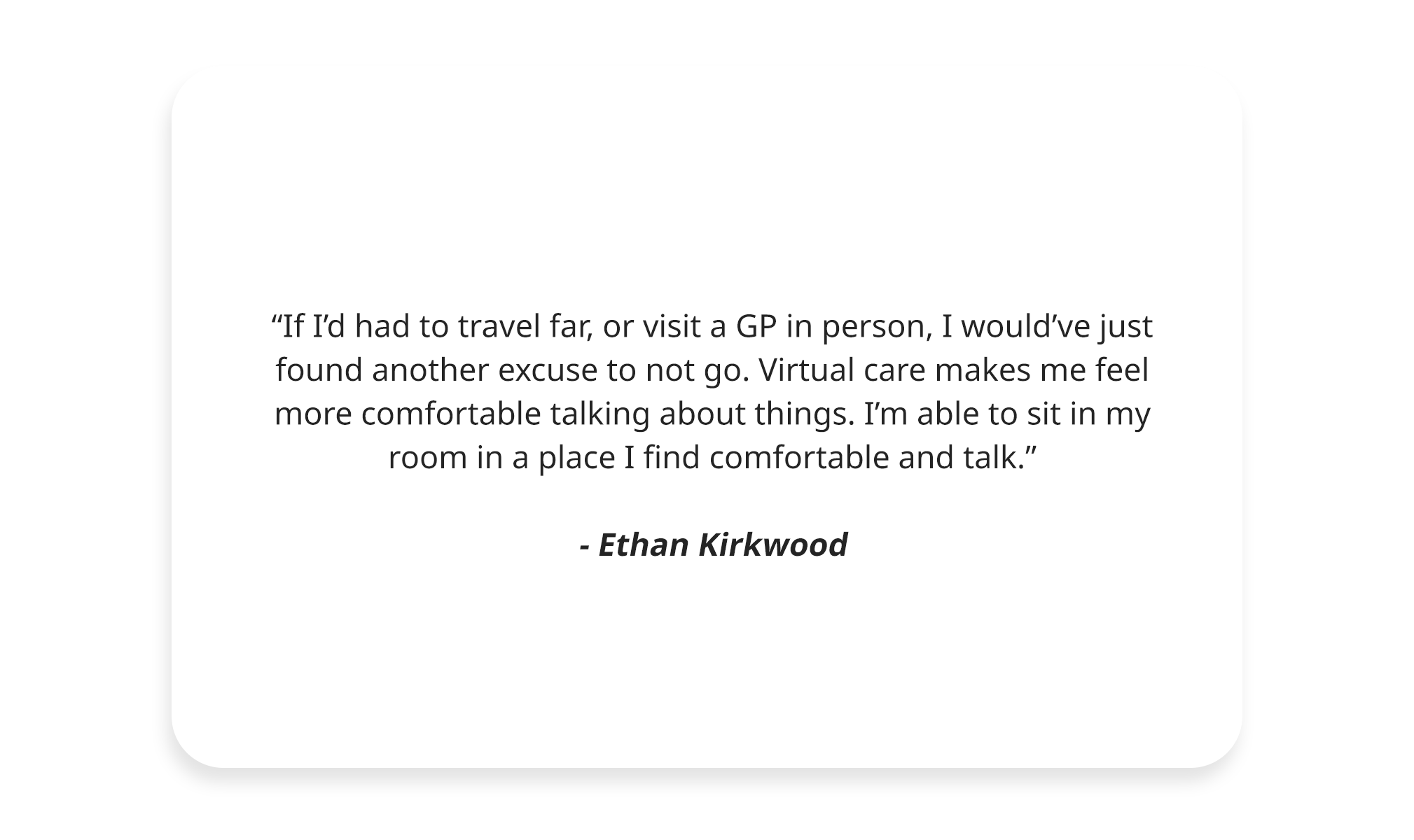
"If I'd had to travel far, or visit a GP in person, I would've just found another excuse to not go. Virtual care makes me feel more comfortable talking about things. I'm able to sit in my room in a place i find comfortable and talk."
- Ethan Kirkwood, Patient
"If I'd had to travel far, or visit a GP in person, I would've just found another excuse to not go. Virtual care makes me feel more comfortable talking about things. I'm able to sit in my room in a place i find comfortable and talk."
- Ethan Kirkwood, Patient
ADHD testing
Understanding your options
There are a few ways to access an ADHD assessment:
NHS
Usually accessed through a GP or education provider. These services are publicly funded, but waiting times can be long depending on your local area.
Right to Choose
You may have the option to choose your assessment provider through a GP referral. This allows you to access certain approved providers without paying privately.
Private providers
You can choose to pay directly for an assessment. This may offer greater flexibility in provider choice and, in some cases, shorter waiting times. Some providers may also offer remote assessments.
Whichever route you choose, the quality of the assessment remains important.
NHS
Right to Choose
Private providers
ADHD testing
What to look for when choosing an ADHD assessment
More providers now offer ADHD assessments, which can make it harder to know what to look for. Asking a few key questions can help you understand the quality of care you will receive.
When comparing providers, consider:

Is the assessment aligned with NICE guidance?
NICE (National Institute for Health and Care Excellence) sets the standard for ADHD care in England.
Is it carried out by a qualified ADHD specialist?
Clinicians should be trained, experienced, and registered with a professional body.
Does it include information from more than one setting?
For example, input from home, school, or work.
Will I receive a clear written report and next steps?
A report should explain the outcome and what happens next.
Does the assessment include objective testing alongside questionnaires?
This can add measurable data to support clinical decision-making.
High-quality assessments are designed to support care decisions, not just provide a diagnosis.

ADHD testing
Why objective testing matters
During an ADHD assessment, clinicians gather two types of information:
Subjective information
How symptoms are experienced in daily life, based on interviews, questionnaires, and input from others (such as parents, partners, or teachers).
Objective information
How attention, activity, and impulse control present during a structured task. Results are compared with people of the same age and sex to understand how typical or atypical the response is.
This can help:
- Understand symptom levels more clearly
- See how symptoms compare with typical ADHD patterns
- Create a baseline clinicians can use to track progress over time
- Support more informed decisions about care
Objective tests, such as QbCheck, can be completed remotely and provide a symptom score and visual report that help patients, parents, and clinicians better understand and monitor symptoms over time.

Attention

Impulsivity

Activity
Understanding your symptoms:
subjective vs objective assessment
The most comprehensive ADHD assessments combine clinical insight with objective data, helping you build a clearer and more complete picture.
Subjective assessment

Based on how you experience symptoms and how they impact daily life
Questionnaires and rating scales
Self-reports alongside information from others (for example parents, partners, teachers, or colleagues)
Clinical interviews exploring symptoms across different settings
Objective assessment
Quantifies how attention, activity, and impulse control present during a standardised task
Computer-based attention test
Results compared with age- and sex-matched reference groups
Helps clinicians identify patterns that may be harder to detect through interviews alone
Understanding your symptoms:
subjective vs objective assessment
The most comprehensive ADHD assessments combine clinical insight with objective data, helping you build a clearer and more complete picture.
Subjective assessment
Based on how you experience symptoms and how they impact daily life
Questionnaires and rating scales
Self-reports alongside information from others (for example parents, partners, teachers, or colleagues)
Clinical interviews exploring symptoms across different settings
Objective assessment
Quantifies how attention, activity, and impulse control present during a standardised task
Computer-based attention test
Results compared with age- and sex-matched reference groups
Helps clinicians identify patterns that may be harder to detect through interviews alone
ADHD testing

Supporting high-quality ADHD assessments
Qbtech develops objective testing tools used by clinicians as part of ADHD assessments across public and private healthcare.
Founded over 20 years ago, Qbtech’s technology is supported by more than 40 clinical research studies and over one million completed tests. It is used by most NHS services in England, as well as private providers, to support clinical decision-making and strengthen assessment quality.
Disclaimer: Qbtech does not provide assessments or medical advice. This page is designed to help you understand what to look for when choosing a provider.
ADHD testing
Exploring private assessment options
Many people explore private ADHD assessments after long NHS wait times. According to NHS Digital, demand for assessments continues to increase across England.
Choosing private care should not mean compromising on quality. An assessment that includes objective testing can provide clearer insight into symptoms and support more informed decisions about care. In some cases, this may also support a smoother transition back into NHS care.*
*Disclaimer: Acceptance into NHS care cannot be guaranteed

ADHD testing
Ready to take the next step?

Explore providers offering ADHD assessments that include objective testing, so you can make an informed decision with confidence. Pricing and pathways vary, so always review what is included before booking.

Provider of neurodevelopmental and psychological assessments, including ADHD, across private and NHS pathways.
UK-based ADHD service provider offering assessment, diagnosis and ongoing support for children and adults.
Online mental health provider offering mental healthcare services and neurodevelopmental assessments across the UK.

Provides ADHD and wider neurodevelopmental assessments for children and adults.
Provider of psychological therapies and personal development to adults, young people, children and families.
Offers private assessments for ADHD & Autism, providing comprehensive support before, during & after diagnosis.
Disclaimer: Qbtech does not provide assessments or medical advice. This page is designed to help you understand what to look for when choosing a provider.
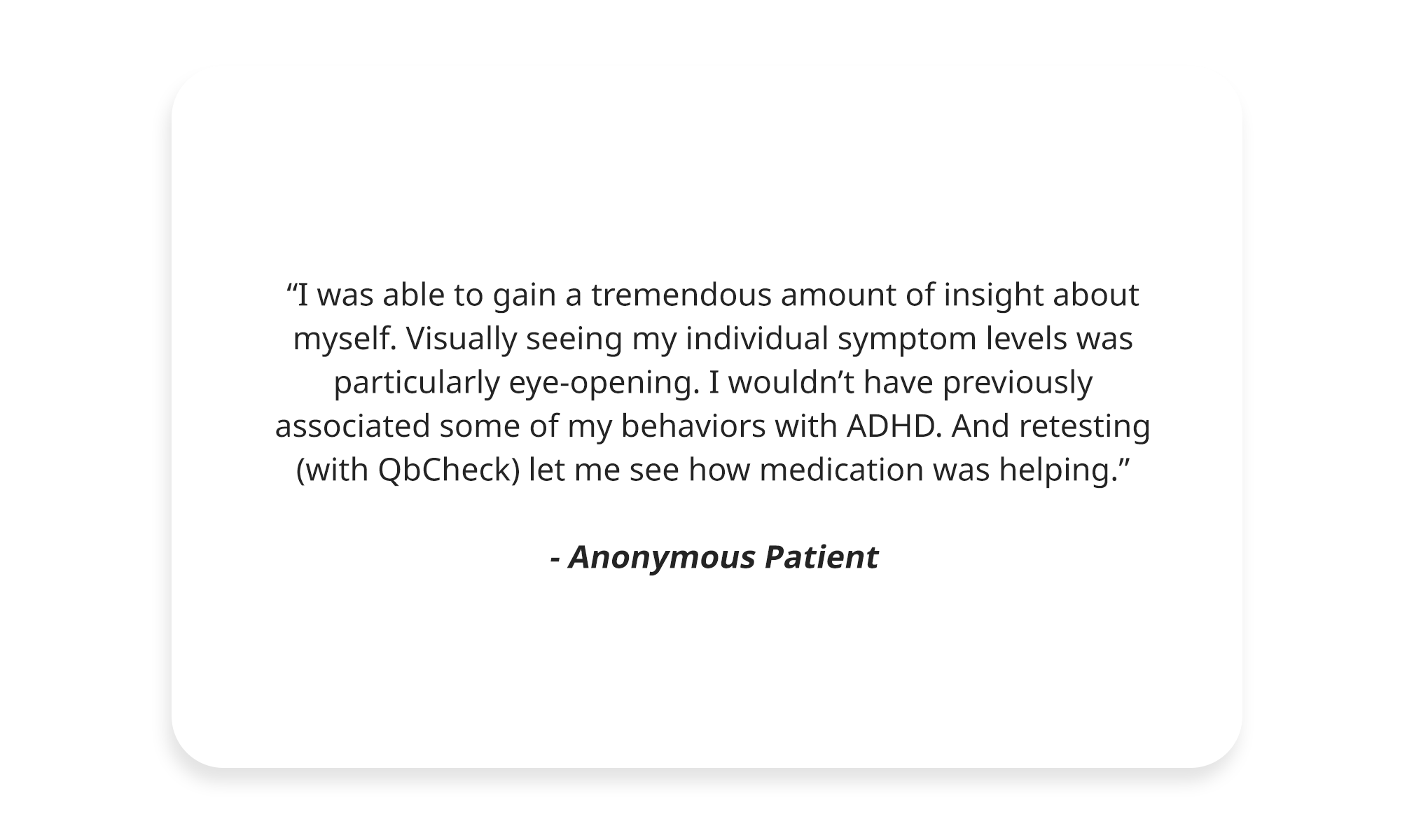
Patient experiences using QbCheck for ADHD testing

ADHD testing
Frequently asked questions
There is no guarantee that a private ADHD diagnosis will be accepted for shared care or ongoing treatment by another service. However, assessments that include objective testing are more robust and may provide greater confidence when reviewed by another clinician.
Yes. Clinicians can diagnose using interviews and rating scales. Objective testing adds another layer of evidence and clarity and has been proven to help clinicians diagnose with greater confidence.
A repeat assessment may be requested if the original diagnosis:
- Relied mainly on self-reported information
- Lacks clear documentation
- Does not provide enough evidence for another clinician to feel confident
More comprehensive assessments are less likely to be repeated.
It depends on the policies of the new provider. More detailed and evidence-based assessments can reduce unnecessary duplication.
These can affect attention. A comprehensive assessment helps clinicians understand overlapping symptoms and reach a clearer conclusion.
No. This page is for education and comparison only. Booking happens directly with the provider.